Friday, August 22, 2014

little Cometa


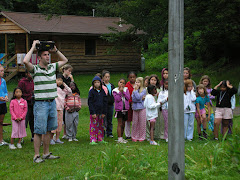
Tom Cometa's younger son Dylan ended his session at camp - his first. He pronounced it "great!"

goodbye, CITs

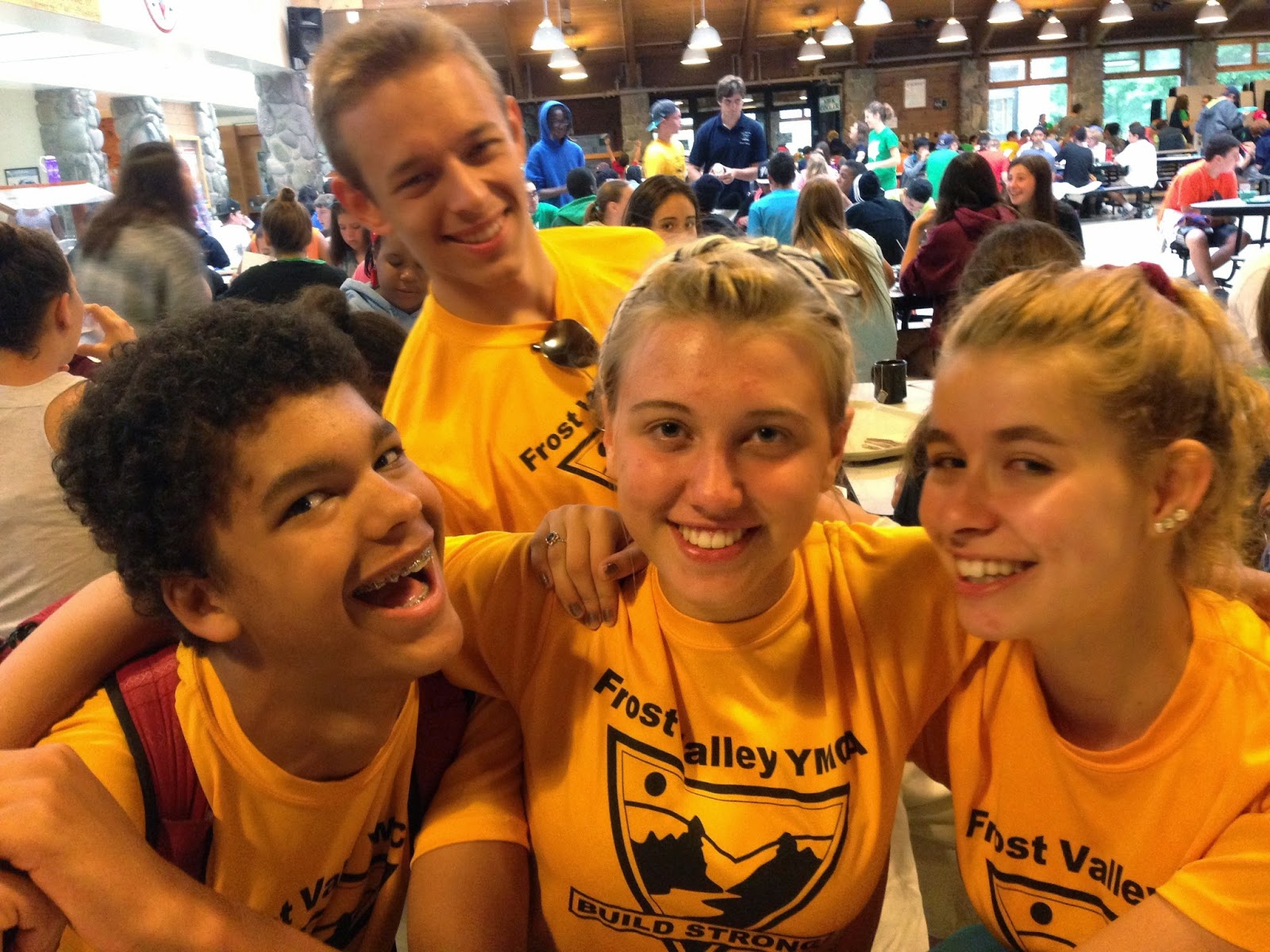
Over at the weepy, sad CIT table this morning at the last breakfast: the coordinators are sanguine and proud, the CITs themselves range from mopey to resigned to happily devastated. Several of them reunited with their parents, who were invited to visit us last night for a special CIT parents' dinner at the Castle. In the fourth photo below, the fellow standing is Christian Brady, a next-generation Brady in the family that brought us Nancy, Wendy, Nancy's twin daughters, and others.


the smelliest shoe


Nanase, a Lakota counselor, was called up to be a special one-challenge judge at Challenge Night the other night. The challenge was.....the notorious....smelliest shoe. From this brief video you get a sense of why this challenge is always that hardest for the judges to handle! If the session has been particularly rainy, it can be quite a treat to put one's nose near this footwear.

the last day

The last day. Oddly, I stood on the Castle porch, looking out toward Slide Mountain - it was utterly quiet - very early this morning. And then I remembered that I had made an audio recording of Hird's final hoopla yesterday after lunch. Eleven minutes of passionate crazy chanting and screaming. If staff get enthusiastic about hoopla all summer, this is always a day when they leave nothing on the field, as it were. One cheer after another. Real fans of hoopla - former staff reading this who are nostalgic of that daily moment - will I hope listen to the whole recording. It's 11 minutes long. Then try to imagine my decision to listen to the whole thing as a recording while I stood on looking out from the Castle at the silent Catskills vista. The two together are camp.

LINK to the audio recording of 2014's final hoopla.

Wednesday, August 20, 2014

what one Mac Girl can do

Watch what one young lady from Mac Girls can do to inspire a whole dining hall to let go, be free, and dance. The music (by which we clean up tables) began and she got up front and just danced away, free and easy. The effect of her beautiful abandon is subtle, so watch closely for it.

new teaching kitchen

Can't believe camp is almost over and I haven't said anything here about the new teaching kitchen. The program in this remarkable new space is a descendent of the "Incredible Edible House," which dates back to 1980 (created during the height of the Wellness Revolution at FV). The new kitchen, funded by a generous grant from a foundation, is located in the bottom floor of Quirk Lodge (next to Victoria Hall). Campers and counselors go there to learn to cook and eat well. Here's a quick video of the space.


random peek at the director's table...

...where a ton of things are going on all at once.

Tehuti Barrett's daughters

Tehuti Barrett (camper in the 80s, staffer later) has two daughters who are in camp now. This is Brianna, in Lakota. She's a happy camper!

breakfast with kids

I just came from breakfast where I dined and conversed with two articulate and fascinating young ladies of Pokey. They are Mika and Cristina. I heard all about their families, their experiences as first-time campers, and many miscellaneous stories. This real conversation was one of the highlights of my summer here, and a simple reminder of what being here is all about. Talking with kids. Even kids this young have clear hopes and fears and dreams and even plans. They care deeply about their parents and are surprisingly knowledgeable about what their parents are going through - jobs, careers, travel, raising a family, caring for elders. They're 8 years old and obviously still quite dependent on adults, but they have the minds and articulateness of people who are ready to grow up and try things out for themselves. Impressive.

One more thing. Both these girls have complex multi-ethnic international families. Mika's family is Moroccan, Israeli and more. Cristina's is Nigerian-Brooklynian (and British), with lots of back and forth, and extended families heading in many directions at once. Both are remarkably interested in their multiple identities and completely comfortable with them. The worldliness of their families, and themselves, is something they deem a natural fact.


say goodbye to Smith Lodge

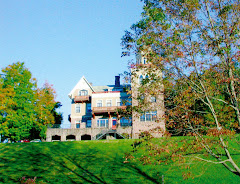
Just a few days after summer camp ends, Smith Lodge, the old Forstmann-era herdsman's house and for decades our "infirmary" or "health center," will be demolished. And then we will build a gorgeous new staff lounge to be named after Eric Blum - The Blum Center. Earlier posts to this blog tell you about the Blum Center, and earlier this summer I included some photos of the plans. Smith Lodge in its current form is just not much for saving, alas. It's done its job, and then some. It's a wreck. The Blum Center will have the look and style of all our camp buildings, so in a few years the Smith/Blum transition won't seem headline news around here. But as I passed by old Smith on my bike this morning, on my way to breakfast, I felt the need to take one last photo of the place. Or two. Then I noticed that there was a huge hawk standing guard atop the chimney. Eerie and beautiful.


Link: Blum Center plans.

perfect late-August blue-sky 360

the look, style - no, culture - of being a counselor

Last night one of the challenges at the Susky-Forest Challenge Night was this: "Send up one camper from each team who might pass as a counselor." The young guy in the photo below won't pass because he looks old enough. No, that's not the point of this challenge when it's for Susky and Forest. But the judges and I noted - not just in this boy's case but for all the contestants - that the campers here at FV just know what a counselor looks like, what they say and how they say what they say. "Style" isn't quite the word. Nor "mode." It's a counselor's way of being, I suppose, as expressed in how they look, the accessories they carry around (coffee cup, backpack, Crazy Creek dangling from the pack, water bottle) and a way of standing--an exhausted yet vibrant look (a paradox, I know). That the kids here get it - many of them - creates a heartfulness, a sense that some of them, many of them indeed, will come of age here and stay on for years, passing it on that exhausted persistent vivacity. I'm not overstating this. It's true. It's a look that tells a whole story of generations. Maybe the best phrase is: a culture. May it live long.


Tuesday, August 19, 2014

interview (audio recording) of conversation with Dr. Bill Primack and Dr. Rick Kaskel about the early days of Frost Valley's dialysis program

Rick Kaskel (left) and Bil Primack (right).
I had the pleasure of recording a conversation with Bill Primack and Rick Kaskel about their experiences during the very first days of the dialysis program at Frost Valley. Click HERE to listen to the discussion, which lasts 12 minutes.

interview (audio recording) of Bev Gross & three of her campers (Jody Davies Ketcham, Debbie Ketcham Goodeve, and Barbie Hale)

This interview took place in the Castle living room on Friday evening, August 15, 2014. The photo here was taken a few hours earlier on the Castle porch. From left to right: Jody Davies Ketcham, Carolyn Shelburne, Debbie Ketcham Goodeve, Billie Ketcham Heath, Bev Gross Sutton, and Barbie Hale. The interview was conducted with Bev Gross and three of her campers (they were actually campers in her cabin): Jody, Debbie, and Barbie. Billie joined the conversation too, and, although she wasn't assigned to Bev's cabin, came to knew her well.
HERE is a link to a 19-minute audio recording of the conversation. One topic was the impact and influence felt by the leaderly presence of Bev Gross during the early days of Girls' Camp at Frost Valley in the early 1960s. Another topic was Bev's close friendship with the late John Ketcham.

40 years after the founding of our dialysis program, we honor Dr. Ira Greifer

I've now posted photos and text about three of the four inductees into the Hall of Fame for 2014. The last is Dr. Ira Greifer. Ira is in poor health and was unable to join us at the luncheon ceremony, but tomorrow (Wed., August 20) Jerry Huncosky and Rick Kaskel will visit Ira at home and present the plaque to him there, and will give him a copy of the "Summer Meeting" program, which includes a long profile of Ira and his involvement as a founder of our project to bring kids with chronic kidney disease to camp. Below is the full text of the profile as it appeared in the program.

* * *
Ira Greifer

In 1974-75, Halbe Brown, Eva Gottscho, and Dr. Ira Greifer came together to co-found The Ruth Gottscho Kidney Center here at Frost Valley. It was the first of its kind—a program through which children with kidney disease could safely attend camp alongside healthy children. Eva brought her Foundation and fierce determination that no child would be forced to look out of a window and watch other kids going to camp without having the same opportunity. Halbe brought this magnificent space and his ability to take risks and his trusting attitude that if “you tell me we can, we will.” And Dr. Greifer brought the resources of a major New York City academic medical center along with his pioneering experience as a pediatric nephrologist.  It is rare to find such synergy and the three of them shared the same vision. [Above from left to right: Eva Gottscho, Halbe Brown, Ira Greifer and Bill Primack.]

Such a thing, in so remote a location, had never been tried, and indeed some thought it was an outlandish idea. Dr. Greifer was at the time the medical director of the Children’s Kidney Center at Albert Einstein Hospital of Medicine (now Montefiore), the largest such unit in the northeast U.S. and the only one in New York State. We must remember that it was only in 1973—just a year before the planning began to create our program—that Medicare began to pay for the costs of dialysis; it was also a time when it was thought too technically difficult to provide this type of therapy to children.

With crucial assistance from Dr. William Primack, one of Dr. Greifer’s first Fellows—his first “ambassador” to Frost Valley for the project—he worked with Frost Valley’s Chuck White on the careful design of the unit, and did what today we would be right to consider the miraculous political work of having the new dialysis unit at Frost Valley designated by the federal government and the State of New York an official satellite of Einstein Hospital in the Bronx.

In Dr. Ira Greifer this stupendous effort found a person with an already growing reputation as a true visionary for inclusive global health in pediatrics—someone who knew medically, institutionally, and ethically how to extend health care to children whose chronic condition had led many in hospitals, schools and, alas, even families, to give up on their ever having a chance to interact with healthy peers. Because of Dr. Greifer’s dauntless vision, children on hemodialysis—in those days just about as restrictive an ongoing medical treatment a child could have to endure—not only interacted with healthy peers at camp, but they swam in a cold mountain lake, played kickball with everyone else, screamed their village’s cheers after lunch, made real lasting friendships, found in their counselors supportive and understanding big brothers and sisters, and—most astonishingly—hiked to overnight campsites and slept out under the stars, far away from the camp’s medical staff and even further from understandably protective (and now remarkably gratified) parents and siblings. Dr. Greifer gave these children, through his vision, the gift of a childhood.

Ira Greifer had entered the field of pediatric nephrology as it was being defined at Albert Einstein College of Medicine by his mentor Dr. Henry Barnett. Very soon Dr. Greifer was himself leading the way in his advocacy on behalf of children’s medical and psycho-social needs (the latter was then a very new consideration), in his support of research and education in nephrology and pediatrics generally, and in his hard pushing for legislation to enable better delivery of health care to kids with chronic illness. He created an innovative family-centered care project, the famed “Mothering in Hospital Program”; worked with Senator Jacob Javits to establish the New York State Kidney Disease Institute; served as medical director of the National Kidney Foundation; made possible the funding of training fellowships that supported more than a thousand Fellows; and played a leadership role in the passage of federal legislation establishing access to dialysis treatment or the opportunity for transplantation as an equal right. Dr Greifer taught several generations of Fellows and his wisdom and sense of “the possible” lives on through them.

With all this going on, and while attaining the position of Director of Pediatrics at Einstein, he was actively involved in Frost Valley’s kidney camp program for a quarter century. He would simply not let the experiment fail, and that was no easy task. Dr. Rick Kaskel, a protégé of Dr. Greifer, was recruited—at the time Rick might have said exiled; he was forced to go!—to Frost Valley in 1978, and was truly astonished when he first saw the hard work being done to support the children while at camp. There were four beds in the unit, each next to a hemodialysis machine; with fifteen to twenty campers, all at first on hemodialysis, the doctors, nurses and technicians were dialyzing the campers six days per week, eight campers per day, each undergoing dialysis treatment every other day. During camp sessions of more than 16 children, there were double and occasionally even triple daily shifts. This intense medical service continued to make mainstreaming at camp possible for these socially and physically vulnerable children, and then in the 1980s, when new treatment modalities became available—transplantation, peritoneal dialysis (requiring sterile CAPD exchanges four times per day)—the capacity of Frost Valley’s kidney camp-within-a-camp to serve chronically ill kids doubled and tripled, and so the already revolutionary program was revolutionized still further. [Above: Rafik Ghobrial introduces the induction of Dr. Greifer, as Rick Kaskel waits to receive the plaque, which he will then give to Dr. Greifer in person.]

Frost Valley’s trustees have already honored Halbe & Eva with induction to the Hall of Fame. It is fitting that the circle is now closed with the induction of the third of these formidable people. The Board of Trustees of Frost Valley YMCA takes this time to recognize a world-renowned leader in pediatrics who has devoted so much insight and energy to the program here, but it is especially appropriate that his entrance into Frost Valley’s Hall of Fame coincides with the fortieth consecutive summer of our kidney program—of the project that was once deemed a truly impossible dream. That such an impossibility is now considered “just part of camp” is itself a testament to Dr. Ira Greifer’s true powers of tenacity and imagination.

Hall of Fame inductee: Clara Hasbrouck

Here, below, is the text of the profile of Clara Morthland Hasbrouck, who was inducted into the Hall of Fame here on Saturday.

* * *

Clara Hasbrouck

Clara Hasbrouck served for seventeen years as a member of Frost Valley’s Board of Trustees, after succeeding the influential trusteeship of her late husband Dr. William E. Morthland. The Frost Valley/Morthland connection had been made first through the fine art of Catskills trout fishing; the  Working with Woody English, the legendary President of the Board of that era, she promulgated the commitment to the Castle’s preservation and its permanent use for schoolchildren and summer campers as a living-learning lab for encountering local social history.
Morthlands had purchased property in Woodstock and it wasn’t long before they had discovered our beautiful Neversink River, long a mecca for serious fishermen and -women in the area. When Clara succeeded Bill as a trustee, she was asked to take responsibility for sorting through the furnishings of the recently acquired home at the Straus-Guggenheim estate, “the Straus House.” She dispatched that project so selflessly and so well that before long the Forstmann Castle was added to her portfolio. “When I took over the Castle, it was a mess,” she recently recalled. “Draperies were falling off the rods. Everything needed attention. It was a great challenge to me, and I like challenges, and that’s why I developed an enduring interest in the fate of this historically important building.” Working with Marie Hess and Executive Director Halbe Brown, Clara spent arduous days sorting through the Castle attic, removing truckloads of junk, rediscovering important pieces in the dust, and (not incidentally) ridding the place of bats. Clara had been an active member of National Trust for Historic Preservation, and now she persuasively applied its principles of conservancy to Frost Valley’s unique place in Catskills history.

Clara was for decades a successful corporate accountant, holding various positions over the years such as assistant corporate treasurer and office manager. Later she took clients and directed a thriving personal accounting business, handling more than a dozen trust funds. Following Dr. Morthland’s death, Clara married Brigadier General Sherman Hasbrouck, who later passed away in 2002. Clara retired, remarkably, at 88 years of age.  Now a nanogenarian, she has lost none of her acute interest in what Frost Valley does for children and families. “Frost Valley has a genuine purpose,” she recently remarked. “It serves adults and children and does it so well. I want people to know what an inspiration it was for me to work on behalf of Frost Valley. It was and is a happy place.” [At right: General Sherman Hasbrouck. When he died at 103 years old in 2002, he was the oldest West Point graduate alive.]

Those who visit the Forstmann Castle today will discover a lovingly conserved and restored mansion—its balconies rebuilt by hand, its complex roof secure, its grand porch strengthened and renovated, its remarkable peg-and-groove floors polished and immaculate. As one enters this astonishing piece of history—all the more astonishing for its being part of a camp—one encounters, in part, the legacy of a strong woman who knew not just how but also why she wanted to help. By unanimous vote of the Frost Valley Board of Trustees, we honor Clara Hasbrouck at her induction into the Frost Valley Hall of Fame for her unwavering commitment to preservation and stewardship. We note that when she first saw the state of the old house, her first thought was this: “A friend in need is a friend indeed.” Today we honor her as a friend indeed—not just a friend of our stately mansion but of everyone at Frost Valley who cherishes stewardship as a core value.

pizza angel

Last night I drove from Philadelphia back to camp. I figured I'd be arriving at around 10:30 PM so, on the way, I stopped at a pizza place in Middletown, picked up a pepperoni, a mushroom and a chicken pizza. When I arrived I warmed it in the Geyer Hall kitchen's oven and went out looking for needy fourth-session hungry/tired staff. I passed by the program office in Margetts Lodge and saw some hard-working but bedraggled folks there. Stopped in, they said "Hi, Al!" and then their heads went back down to their work. I said, "Do you prefer mushroom, pepperoni, and chicken?" Heads back up. Quizzical looks. "A pizza. Do you want a pizza?" "Here? Now? Really?" "Yes!" "Chicken!!" they shouted. It was warm and ready, and I brought it in. Their moods lightened immediately and we all started talking and laughing. Amazing how little it takes here at camp to make people happy. The video below gives you a sense of it!

Later I did the same at the Hemlock (pepperoni) and Lakota (mushroom) CQ fires. It was delightful. The sky was full of stars, the temperatures cold, the fires raging, and the pizza angel had done his thing. Final-week fun.


Monday, August 18, 2014

Summer Meeting 2014

Below are photos I took at Saturday's "Summer Meeting." The event combines a summertime meeting of the Frost Valley trustees with a ceremonial gathering for lunch - with Hall of Fame inductions, the announcement of the Eric Blum Volunteer of the Year Award (which was given to me this year, a complete and utter honor!), and presentations by campers and staff. The audience consists of trustees and their families, some alumni, the Hall of Fame inductees and/or their families and friends, some parents of summer campers, et alia. The photos of people behind the podium were taken by Dan Weir, by the way; full credit to Dan with his zoom lens!

The night before the Saturday gathering, a bunch of us met at the Castle for a dinner, which began with wine and snacks on the newly renovated Castle porch. Here is where we all got a wonderful surprise: Bev Gross Sutton, whom we knew in the 1960s at camp as Bev Gross, arrived with her partner Gordon. Bev had not been back to Frost Valley in 45 years. 45 years! She was, as I have mentioned elsewhere, a legendary Girls' Camp leader. And this was emphasized time and time again over the weekend, as women who themselves became camp leaders repeatedly described Bev is formatively inspirational. Here we have three of Bev's former campers standing with her. Yes, these three - Jody Ketcham, Debbie Ketcham Goodeve, and Billie Ketcham Heather - were all actually campers in Bev's cabins, either in Pokey or in Susky. This was quite a reunion. Later I will post the audio recording of a discussion I had with the four of them plus Barbara Hale who was also in Bev's cabin. It was quite something.
Now Barbie Hale (far right) and Carolyn Shelburne (white jacket) join the Girls' Camp gang. Carolyn arrived at FV just after Bev Gross left in the late '60s, but, as Carolyn noted, everyone asked her then, "Did you know Bev Gross?"

After the Castle dinner on Friday night, from left to right: Carolyn Shelburn, Rick Kaskel, Bill Primack, me, and Phyllis Kaskel.

At breakfast on Saturday morning. Bev was still stunned by being back at Wawayanda. The Wawayanda kids and counselors were eating just then in the main room, so I went and ask Phoebe, the Pokey-Totem VC, if she wanted to meet her predecessor Pokey VC, and she did. So she and camper Audrey came back. Turns out that Billie Ketcham Heath was also a Pokey VC, so here you have three of them, reaching across camp history.

At the luncheon on Saturday: Andy comes over from the Farm and offers a remarkable "Farmer's Market," a cornucopia of veggies from the Farm's gardens. Amazing.

John Lucus Ketcham, looking just like his late grandfather John Ketcham, hangs around the Eva Gottscho memorial bench at Reflection Pond, while the Ketcham family, and friends, gather to bury Casey Ketcham's ashes on Memorial Island.


Jim Ewen (also a close camp friend of Bev Gross) sitting with Carolyn.

The Schnauffers, legendary Family Camp folks who have probably been to FV's weeklong end-of-summer family camp longer than any other family. Their grandson Carson was an Outpost camper this summer - and what a winner he is!

Jeff Daly and Mark Gottdenker. I was pleased to see Eric Blum's dearest friends at the even where I received the award named for Eric.

The whole crew of folks associated with FV's extraordinary dialysis program over the years. What a reunion. Probably there's never been such a gathering ever. This summer the program was operating in its 40th consecutive summer.

Rafik Ghobrial (whom staffers from the late 1970s will remember as Rafik Melek) is now a prominent liver transplant surgeon, and director of his department at his Houston TX hospital - quite eminent in his field!  His original interest in transplantation developed during his first summer as a counselor at FV, when he spent time working with kids with chronic kidney disease and met the doctors and nurses associated with the unit. Here Rafik is presenting the Hall of Fame induction for Dr. Ira Greifer. Ira is ill and was not able to come to FV to receive the award. Rick Kaskel accepted on his behalf, and soon Rick and Jerry Huncosky will visit Ira and present it to him in person.


Three prominent pediatric nephrologists and one super-eminent transplant surgeon: from left to right - Rafik, Lou Reisman, Rick Kaskel, and Bill Primack. I will have more to say about them when I post a blog entry on the induction of Ira Greifer into the Hall of Fame. But for now it suffices to say this: can you imagine a camp - a summer camp! - that would draw such eminent medical people all these distances to come to note the occasion of the 40th anniversary of a camp program? If you know anything about how busy these medical high-ups are, what demands there are on their time, how little room they have for traveling, etc., and how high-level and intense are the hospital politics, you'll really appreciate my own mouth-dropping sense of this gathering. And they are all such sweet generous people, whose medical care has saved the lives of hundreds and probably thousands of children suffering from renal failure, and who pushed well beyond making it possible for these kids to live - who indeed sought the establishment of a program that would enable the kids to have a "normal" experience with healthy peers. In the first photo above, Rafik is bowing down to honor the kidney guys (a mocking gesture, to be sure).

Now Stuart Kaufer has joined the crew. As dialysis technician and for many summers the coordinator of the dialysis unit at FV - a legendary character beloved by everyone in camp, counselors and directors and not just medical people - Stu spent every summer from 1978 through 1984 at camp, working countless hours and totally devoted to the kids.

Jim Ewen and Bev Gross, dear camp friends seeing each other for the first time in 45 years.

Lou Reisman and Jane and I took a walk around camp after the luncheon. Here was chatted with leaders of the MAC program, Gail Morris, Rae Nathanson, and Amani Danielian.

Nadia gave a talk about her experience as a kidney transplant patient who attended camp as a camper and is now a junior counselor on the staff. It was a beautiful speech!

The dialysis crew again. That's Judy Eichinger, Eva Gottscho's daughter, standing to the left (our right) of Rafik.

Here we are, singing grace in three-part harmony. "Father for this noonday meal, we should speak the praise we feel..." We sung it "Girls Camp" style, which today is the only tune used at camp. The Wawayanda tune has mostly been forgotten. Mike Ketcham wanted us to sing that one, but we ended up singing the version with the easy harmonies.

I'm speaking here after receiving the Eric Blum Volunteer of the Year Award. I had the pleasure of speaking directly in front of my wife Jane, my son Ben, and my daughter Hannah. I thanked each of them for tolerating my mania for returning to camp every summer!

Mike Ketcham talks about his father Frank.

Rafik Ghobrial talks about Ira Greifer and miracle of the dialysis program as it was created (with great risks) in 1975.

Rick Kaskel accepting Ira's induction on Ira's behalf.

Paul Guenther, former long-time Chairman of FV's Board and the major donor to the Guenther Family Wellness Center, introduced my award. It was an honor to have Paul do that.

Bob Lomauro is a member of FV's board now. His wife Lisa and daughter Lauren joined him. Lauren of course was a long-time camper and staffer, and she was my daughter's counselor when Hannah was a camper in Lakota. After the festivities, Lauren visited the weekly Leadership Meeting (VC meeting for program planning) and there found her former camper....planning Lakota's final week's schedule!

Here's Lauren with John Butler. John just returned to the NY/NJ area after several years at Stanford. He hadn't been back to FV in quite a while and seemed to enjoy getting back into the swing of things.

John Ketcham inducted posthumously into the Hall of Fame

The late John Ketcham was inducted—tears flowing and hearts full of remembrance of this generous beautiful guy who died far, far too early—into the FV Hall of Fame on Saturday, along with his late father Frank. Earlier that morning, the Ketcham family, led by Jody Davies Ketcham, buried the ashes of John's and Jody's daughter Casey. I attended that service/meeting and then the burial, and I can hardly put words to how deep and moving it all was. We gathered in the Ketcham Chapel to remember Casey and then walked over onto Memorial Island to lay the ashes, sing a simple song, and then walk slowly over to the other side of the Biscuit Creek bridge where soon it was time to remember Casey's father John. Meantime, John's son Steve was on hand and his wife Ali and their new son John Lucas, whom we couldn't help but call John. And, oh my, does John look like Johnny Ketcham, his grandfather, when he was a baby. Readers of this blog can simply compare the new John Ketcham to the photo of Johnny with Frank and Mike at Wawayanda in 1948. Amazing likeness. Below you see a photo of John's dearest Wawayanda friend, Bev Gross Sutton, to whom little John took as if they were continuing the friendship Bev and John commenced in the very early days of Wawayanda at Frost Valley. Bev's letter to Casey, after her father's death, is quoted in the profile we wrote about John on the occasion of his induction. Steve gave the intruction speech, and Jody accepted the plaque on behalf of her late husband.

Click here to see and read a copy of the profile as it appeared in the program.

Photo above: We gather at Memorial Island in Reflection Pond to bury Casey's ashes.


John Ketcham

Bev Gross (now Bev Gross Sutton, legendary Girls’ Camp personage in her own right) met Johnny Ketcham at Wawayanda when they were teenagers. They grew up there and worked as waterfront counselors together for several summers, after which they remained close friends for a lifetime. Soon after John’s death—cancer took him far, far too young—Bev decided to describe her experiences with and feelings about John in a long letter to Casey, John and Jody Davies Ketcham’s daughter. “What I remember most vividly about working on the waterfront with your dad,” Bev told Casey,

was that Lake Cole in June felt like swimming in glacial waters. It took your breath away; it paralyzed your limbs. Every counselor struggled to seduce the children to swim, but every camper balked at every suggestion....every camper except, of course, the campers in Johnny's group. He and his kids would be in the water, splashing happily and practicing their strokes. When his children emerged from their lessons, their toes and fingers were purple, their teeth were chattering and they were covered with goose bumps the size of jelly beans. Yet a radiant smile always framed their blue lips. John knew how to inspire people to reach beyond their grasp.

Everyone who encountered John Ketcham felt this particular kind of inspiration—the kind that shows you how to live rather than tells you; the kind that creates confidence with a smile and modest show of physical and emotional strength; the kind that made everyone around him “reach beyond their grasp.” Today we honor John Ketcham with induction into the Frost Valley Hall of Fame—and with sorrow we must do it posthumously—in the realization that no one who has graced this Valley ever better embodied the values of caring, respect, and responsibility together in one soul. He was unfailingly kind to everyone; he loved Wawayanda and Frost Valley and did everything he could, always, to make it a better place for kids; he accepted far more than his share of commitments and complex burdens and never diminished his capacity for love in doing so.

Bev Gross Sutton holds John Ketcham's grandson.
He’d been a baby when first being taken to Wawayanda in 1948. He attended camp at the temporary Wawayanda site at Stevens Institute in the 1950s, and by 15, now at Frost Valley, he was a young CIT (normally 16). Then, at 16, a very young counselor, his superstar capacities as leader of children and colleagues became fully apparent, and he was appointed to be a Village Chief—of Hemlock (his campers thus being just two years younger than he): the youngest Village Chief in the long history of our camp. Soon he was Frost Valley’s Waterfront Director, not just accepting and fulfilling responsibility for safety at an area of camp entailing special risks but going much further: John helped re-introduce YMCA-style swimming instruction and, as Bev Gross noted for Casey, managed to make it the most fun place to be in camp. He’d been a champion swimmer at Westfield High School, and then at Wesleyan University, where he won fourth place in the 100-yard backstroke as a Collegiate All-American in Division 1 of the NCAA—an astonishing feat considering that Wesleyan, a tiny college, is a Division 3 school.

John's sister Billie Ketcham Heath says a few words.
Starting in 1975 he worked with his father Frank in the accounting firm, Ketcham & Ketcham. He was writing early computer programs to aid accounting practices, and Frost Valley was a beta testing site. As he worked on this with Halbe Brown—by this point the Brown and Ketcham families were very close—he was persuaded by Halbe of the value of another seemingly crazy Frost Valley innovation: a specialty camp for kids focusing on computers. John developed the program and for at least one two-week session taught the children himself. There he re-met another family friend from their Westfield days, Jody Davies, then Frost Valley’s director of development. They became one of several Ketcham marriages that began at Frost Valley, and they were wed, at the Straus Estate, in 1986. John’s children, Bill, Steve, and Suzy, all attended camp and came of age here, in the Ketcham tradition. John and Jody’s daughters, Casey and Molly, were born in 1991; their ashes rest, with John’s, on Memorial Island at Reflection Pond. Casey loved her many visits to Frost Valley—family reunion weekends, family camp, visits for meetings and staff reunions and memorials—and John loved that Casey loved his beloved Wawayanda, home to his sense of leadership and his belief in the power of children’s imagination and hope.

John’s death was a great blow to that hope. But, as Bev wrote Casey, “Every one who knew Johnny, every one who ministered to him during his illness, every one who attended his service, has been changed for the better.  We have each been summoned, in his name, to follow his example. I hope you can find solace in knowing that you are the child of a truly great man.” If there were just one reason for Frost Valley’s Hall of Fame, it would surely be this: to remind ourselves of such powerful examples of our Frost Valley predecessors; to accept their loss as a challenge to make something better here for children and families; to take solace as friends and family and colleagues of a truly great man; to dive into the frigid water in that same hopeful spirit and “splash happily”—inspiring people always and forever to reach beyond their grasp.