It's the last day of the session sometime in the early 1970s. Time for the CITs and others to put the luggage on the "White Rat." This was a 1951 Chevy truck that was the mainstay luggage and all-camp-program vehicle for many, many years. Eventually it was supplemented by a nice big blue stake truck, and other late model vehicles. But the White Rat was the one. It's shock absorbers (such as they were) created a hilarious (and perhaps dangerous) bounce up the rocky hills going up to the cabins. It's wooden stakes would literally fly up into the air and fall to the ground on some of these trips up.
Wednesday, June 29, 2011
the White Rat truck on luggage day
It's the last day of the session sometime in the early 1970s. Time for the CITs and others to put the luggage on the "White Rat." This was a 1951 Chevy truck that was the mainstay luggage and all-camp-program vehicle for many, many years. Eventually it was supplemented by a nice big blue stake truck, and other late model vehicles. But the White Rat was the one. It's shock absorbers (such as they were) created a hilarious (and perhaps dangerous) bounce up the rocky hills going up to the cabins. It's wooden stakes would literally fly up into the air and fall to the ground on some of these trips up.


swimming at Farm Camp

 Did you know that at Farm Camp the campers swim in the East Branch of the Neversink River? There's a pool (not deep - but certainly swimmable) just across the road from the vegetable plots. Andy Szymczak, I'm delighted to say, is the new director of the Farm Camp. Above you see him chatting with Jerry Huncosky. The air was warm and the water, well, the water was frigid. But the boys we spoke to just loved swimming in such clear water. Even with all the mucking around kids do when they swim and play in water, the river retained its crystal clarity. Amazing.
new sign at White Pond

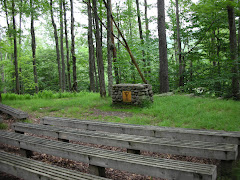
 Yesterday a new sign was installed at White Pond. Click on the top image above, and if you have good eyesight you can see that under "fast facts" we indicate that White Pond was built and is dedicated to Chuck White.
at the East Valley Ranch


 Readers of this blog might not be aware of the changes taking place at the Straus estate. Since the 1970s, when Frost Valley acquired the land and buildings on this property along the East Branch of the Neversink River, what we've called "Straus" or "Straus House" has served as a conference retreat for families and small groups, all year including summer. But with the dramatic increase in excitement about our various horseback riding programs here in the west valley, and with the decrease in interest in the use of Straus by family and other groups in the summer months, we decided to create an Equestrian Camp there. It will run only during the summer months, while the September-mid-June schedule will remain mostly the same as before. As you see from the photos I took there yesterday, the EVR (East Valley Ranch) is up and running. For this early 1-week session ("session A") the horsebarn is finished and filled with horses; the yurts in which the campers sleep are all set up; the bathhouse is gorgeous and ready to be used; and the main house will now begin to serve, summertimes, as housing for some staff and of course the dining hall for the campers and staff in the program. EVR is just for girls; various ranch programs in main camp typically fill with all girls anyway, so we decided to make that official when opening EVR. Ranch campers, horseback riding lessons, and the special "Mustang Village" in the main camp in our traditional west valley location, will continue, and boys can sign up for those. But this turns out to be a girls' thing. There's already a ton of community building going on. Jerry Huncosky and I visited there yesterday and were stunned by how paradisal the whole situation is. We will go back there again today to have lunch with the campers, after which I'll lead them in some songs.
Monday, June 27, 2011
invasion of Ketchams


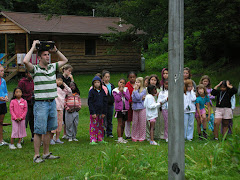
 Three of the newest generation Ketchams arrived yesterday. Cole and Isaac, and Kalayla. Amy (at right), who was once herself a camp director here, is very very eager (to say the least) to know how the boys are doing, so this blog post serves that purpose in part. Amy: They're doing fine! We did a challenge contest this morning and, as you see, there was a Ketcham represented in the Junior Architect challenge and in the weirdest boy contortion challenge.
the Beirut connection

 Looking over the camper list just prior to their arrival yesterday, I noticed two with the last name of "Hibri." This put me in mind of Bassem El-Hibri, whom I knew as a young man from Beirut, Lebanon. Bassem attended a Y camp in the mountains of Lebanon and somehow through that experience met Paul Brown, Halbe Brown's brother. Paul was doing an international Y stint in the middle east. (I think David Allen met Paul, and perhaps Paul and Bassem, over there too. David was in Egypt, I think.) Anyway, Bassem found out about Frost Valley from Paul and arrived in 1973 (in the midst of war and civil war back home). He was here in '73, '74, and '75, possibly '76 too. One summer he was the Totem village chief. Another summer he climbed all 46 high peaks of the Adirondacks with Bud Cox and a group of boys on an Adventure trip. He and I became pretty close friends and spent some wonderful days off together in '75.
I lost touch with Bassem a few years later. Last I heard, he had moved to the U.S. and was running an import/export business in South Carolina.
"Hibri" on the camper list. Okay. Then I promptly forgot about all this and went on with my check-in afternoon. Coming back from taking a family up the hill to a cabin, I ran into staffer Jessica Dymond who said that someone named Hibri was looking for me. His first name was Nadi. He was in fact Bassem's brother!
Nadi and his family live in Texas, where he is an MD (radiologist). "My brother has told me for many years that Frost Valley changed his life - that I must bring my own children here." So from Texas they came - with son Omar and daughter Nadia. As they drove a car along the New York highways, Bassem called his brother from Lebanon and asked where he was. "We are driving to Frost Valley!" "Oh! When you get there, look for Al." So they did.
Yes, Bassem is back in Beirut (running a business). So now I'm aiming to get back in touch with him. Meantime, Omar, as you see above, tried his hand at limbo in the Challenge contest this morning. He was eliminated fairly early (big guy) but seemed to have fun.
- - -
David Allen notes: "I met Paul Brown in Beirut but Rich Hanna new him there better. Rich came to Frost Valley first, and called me about an opening. Definitely a Beirut connection though. Part of my childhood was in Egypt, some teen years in Lebanon."
Jere Schwait's daughter Maya is here too
 Jere Schwait Sirkis has brought her daughter Maya to several alumni reunions. When Maya was quite young, I remember how much she loved playing Geronimo. This must have been in 2006. Now she's 7 years ago and of course it's time for camp. The morning of the first full camp day, after presumably a lively night of late chatting in the cabin, Maya seems none the worse for wear. That's Maya in the middle. And as you see Helen Cornman's daughter is at left. Two alumni kids in the same cabin, by chance.
camper 1979-85 now brings his two sons here
 Also arriving for the one-week camp - which we sometimes think of as a "starter" session for new campers who've not been away from home - are the two sons of Charles Colajiuri and his wife Liz.
 Charles was a camper here from 1979 through 1985 and remembered me as his camp director all through those years, first in Wawayanda ('79 was my first summer as director) and then in Hird (when we split anew into older and younger camps).
Charles saw me in the dining hall and couldn't believe his eyes. Was I still here? We took the boys to their cabin and settled them in, talking all the way about Charles' great feats as a camper, including his achievement as Honor Camper at least one summer.
Then he and Liz set off on a long nostalgic walk around the camp. Charles had last been here in 1986.
two new Cornmans
 Summer 2011. Session "A" began yesterday, a one-week session occuring while staff training is going on. (Some veteran staff are serving as VCs and counselors in the two session A villages - Thunderbird for boys and Moonshadow for girls.
Above you see Helen Cornman arriving with her two children who are attending camp here for the first time! (With Helen is her nephew, Dan Weir, our fabulous Director of Camping Services.)
Friday, June 10, 2011
Mike Ketcham per Dave King
Dave King writes:
"I first met Mike as a camper in the first Lenape Village at Camp Wawayanda in Frost Valley in 1958. He and Bill Haney were together in Cabin # 18, and Jessie Arey was their counselor. It was obvious that Mike had been to camp before, and was great in the village. When we had the first "Olympics", I found out how great an athlete (swimmer) that Mike was. However, I came to realize over many years, that Mike was a true living definition of a "gestalt". Mike was a whole far greater than the sum of his parts.The variety of positions that he held at Frost Valley, his life as a family man, his work in the "Y", are all a part of the pieces which comprise the "picture" of Mike. That one of "my kids" is retiring is a shock to my central nervous system! I am proud of the man that he has become, of his accomplishments, and of his contributions toward making our world a better place!"
"I first met Mike as a camper in the first Lenape Village at Camp Wawayanda in Frost Valley in 1958. He and Bill Haney were together in Cabin # 18, and Jessie Arey was their counselor. It was obvious that Mike had been to camp before, and was great in the village. When we had the first "Olympics", I found out how great an athlete (swimmer) that Mike was. However, I came to realize over many years, that Mike was a true living definition of a "gestalt". Mike was a whole far greater than the sum of his parts.The variety of positions that he held at Frost Valley, his life as a family man, his work in the "Y", are all a part of the pieces which comprise the "picture" of Mike. That one of "my kids" is retiring is a shock to my central nervous system! I am proud of the man that he has become, of his accomplishments, and of his contributions toward making our world a better place!"
Thursday, June 9, 2011
Frost Valley of the Pacific Northwest
 David Scherer Water tells the following wonderful story about what happened when he looked for a camp for his son in the Seattle area. Dave knew that sending Random to Frost Valley entailed too much travel, but he hoped he'd find a little Frost Valley out there. Well, he found Camp Seymour and got a lot more of Frost Valley than he ever imagined. Here's how he tells the story:
'Living in Olympia it just wasn't practical to send Random to Frost Valley and I've always felt kind of sad about that. I looked into the closest Y camps and discovered Camp Seymour was only 40 minutes away. When Random was 4 the two of us did a family camp program and had a blast. The camp reminded me so much of Frost Valley, but I figured this was because all camps reminded me of Frost Valley. Then I met Mike. At first I didn't know that he was from Frost Valley. I even made a joke about his last name being a classic camp name and told him how there was all kinds of things named "Ketcham" at my old camp and wondered if he was part of a secret society. It was one of those small world kind of moments, the kind of uncanny coincidence that made me wonder if some mystical camp force was at work. I would have preferred to have had Random continue the tradition of going to Frost Valley (he'd be the 3rd generation of Frost Valley campers in our family), but Camp Seymour has also become very much a home for us too. I am grateful for the ways Mike transplanted a lot of the Frost Valley culture to Camp Seymour. Random continued as a camper at Seymour and has a group of camp friends that he stays in touch with. I've been to several workshops at Seymour. I think of it as the Frost Valley of the Pacific Northwest.'
-David Scherer Water
Olympia, WA
the Ketchams in 1958
Chester McLemore recalls: "In 1958, the first year at Frost Valley, Mike Ketcham was probably 14 or so. He was a Jr. Counselor and was assigned to my cabin. He was quite and involved with the staff in our village. We were in Cabin 10. Mike DeVita was the village chief and Mike's Brother, John, was a camper in my cabin. It was a great summer. Of all the campers that I had in the 3 years that I was at Wawayanda, I mostly remember the Ketchams, Mon, Dad, Mike and John. It's been so long since this happened that I do not remember specifics, but I do have good feelings when I think of Mike, John and the family. Their sense of family has always been with me."
Tuesday, April 19, 2011
Forest village, 1980
 Mark Gottdenker's mother recently found a village photo taken in 1980 of Forest village. Mark was a Forest camper that summer. Here is what Mark writes about the photo:
To give you an idea how long ago this was taken, my own mother couldn't pick me (or my older brother David) out from the campers in the photo!
I was a camper in cabin 6 (with Dave Hall, standing counselor on the far left of the photo) and my brother was in cabin 9 or 10 (with Scott Robinov, standing second from the right). Other village staff included Tom Frankowiak, Greg Aggs, Gigo from Egypt, and Jim Neilson.
I believe that you blogged about this staff during last summer when Greg visited the Valley with his family and soon after Jim dropped off his daughter for an adventure trip. Hopfully this will put faces with the names.
Wednesday, March 23, 2011
snow again
 It's snowing at Frost Valley again today. Oh goodness. I don't think the photo above was taken today but it was taken during this long and snowy winter.
Thursday, March 10, 2011
Pokey-Totem for the 90s
 Karen Carnegie Johnson ("KC") has scanned and put up on Facebook a number of weekly village schedules for Pokey-Totem from the 90s. Above is one of them.
Pam McPhee (Pam Kerr) wins award
 Pam McPhee at the University of New Hampshire has won an award. We knew her as Pam Kerr, long-time FV'er and member of a significant FV family. Brother Doug, who has been mentioned in this blog several times, also came of age at Frost Valley--and for a time lived (with Leslie Black and their son Jake Kerr) in the valley as a full-time maintenance department staff. Pam doubtless learned a great deal about outdoor education--"experiential education" as it is called in her field--from her FV years and we're thrilled that she is being acknowledged.
 Mark Gottdenker writes: "She was my advisor briefly while I attended UNH. Our shared Frost Valley connection was always a great source of pride. She is a great example of someone taking many of the honorable traits we preach and work to instill in youth at camp and putting them into practice everyday in the world."
Sunday, February 27, 2011
Michael Pitcher remembers Wawayanda in the early 60s
Memories of Camp in the USA
 I’m the little boy from Canada in Homer McLemore’s Summer of ’63 Totem group. I follow Al Filreis's blog closely these days because it reconnects me with very fond memories of a very special time.
I lived in the middle north of the province of Quebec in the early 60’s, a town then called Chibougamau….I could spell it long before the nuns at the town’s French School taught me how to read write and such. My Dad and his close friends were young men in a frontier mining town, full of family commitment and small town spirit. They loved to fish and their stories left you rolling on the floor…..sunken canoes, lost paddles, fish that jumped back out of their boats and such. They met Jim Wilkes and the Trailblazers in the summer of ’62 I think. They were awesome…they had this 3-ton Dark Blue Ford Stake truck and trailer full of 8 shiny aluminum canoes….they were like a busload of big brothers and they were full of great adventure…..that summer flew by. We waved goodbye to them in late summer….to the truck and guys that is. I remember they left the trailer full of canoes…..man I was proud of it. And they were from “way down south”. I didn’t know that Canada and the US were really separate countries, I remember feeling more like they were great folks from another part of the same country and we all loved adventure, the outdoors and having a good time. This was the early sixties and we lived outside of town on a small lake at the base of a big hill on top of which was located a brand new Dew Line Radar Station and its Observatory like Radar Dish Building….I had no idea what the Cold War was….I did listen to John Glenn on the radio as he orbited the earth and often saw the multiple contrails of the B-52’s going north “on manoeveurs”. I felt a part of the same world these Trailblazers lived in.
The next summer came all too slow but boy when they rolled back into town I was thrilled….we hung out by the campfire each night they were there and when they went off into the woods on their “trailblazing” trip I waited eagerly for their return…course I missed my dad too.
Then something magical happened…..I got to leave with them when the first group went “home” . Somehow I remember sitting in a school bus learning to sing, “If I had a hammer…” “Runnin through a swamp….” ( it had sound effects), and most of all “This Land is Your Land”……man it’s great to listen to Woody Guthrie singing this on “YouTube” these days….I remember staying at the bus drivers house one night in Liberty, N.Y. and I remember a lot of neat things about my first summer at camp. I’ve got the original picture that Homer McLemore sent to my mother in 2003. It’s the one in Al Filreis’ blog with Homer leading Totem on a hike…likely to the Neversink River or some other really great place. I’m the little guy second in line behind Homer. By the way I also remember the wild “ghost stories” the cabin leaders used to tell us around the campfires in the “sleepy hollows” around Wawayanda.
I got to go to “W” two summers in a row ( I got two “W” patches!) and the second time got to stay in the Castle when I was picked up at the end of the summer. I think it was 1963. That October we moved out of the north and into the Ottawa, Canada’s Capital City and way south of a land I’d lived in for 11 years… I was in public school in November 1963 and I remember President Kennedy.
I remember the morning flag raising at Camp Wawayanda, pledging allegiance to the Flag of the USA and signing the Star Spangled Banner. Most especially I am deeply touched and very grateful for the incredible experiences I enjoyed those summers in the Catskills with other kids who got together to have fun, shoot arrows, eat Fudgsicles from the canteen, watch 50’s sci-fi movies in the “barn” [the “Rec Hall” – now Margetts], be an Olympian from Siam….etc, etc.
Today I live on the West Coast. Actually “off” the West Coast on Vancouver Island. My wife, Bernadette and I own a busy bakery in the Comox Valley…just north of the middle of the island; 2,445 (Google) miles across North America from Frost Valley. We’ve moved in and out of corporate careers, travelled half-way round the world to work as short term missionaries in England, Turkey and Uzbekistan and returned home to live in our busy valley.
I love the Seattle Mariners, The Montreal Canadiens and pretty much everything in between about both countries.
I’ve had a tremendous number of great experiences these past 56 years. Who I am and what I’ve done has a lot to do with the lessons learned when I got to go to camp. I’m sure anyone reading this has similar tales to tell….I know I’ve enjoyed reading the many that are on Al’s Blog . New or old the tales tell the timeless truth…our great adventures start early in life and leave the most meaningful lessons.
I still feel a small part of a big family full of great spirit.
In a few words with much meaning …..thank-you.
Michael Pitcher
The little boy from Canada. 1963

 I’m the little boy from Canada in Homer McLemore’s Summer of ’63 Totem group. I follow Al Filreis's blog closely these days because it reconnects me with very fond memories of a very special time.
 I lived in the middle north of the province of Quebec in the early 60’s, a town then called Chibougamau….I could spell it long before the nuns at the town’s French School taught me how to read write and such. My Dad and his close friends were young men in a frontier mining town, full of family commitment and small town spirit. They loved to fish and their stories left you rolling on the floor…..sunken canoes, lost paddles, fish that jumped back out of their boats and such. They met Jim Wilkes and the Trailblazers in the summer of ’62 I think. They were awesome…they had this 3-ton Dark Blue Ford Stake truck and trailer full of 8 shiny aluminum canoes….they were like a busload of big brothers and they were full of great adventure…..that summer flew by. We waved goodbye to them in late summer….to the truck and guys that is. I remember they left the trailer full of canoes…..man I was proud of it. And they were from “way down south”. I didn’t know that Canada and the US were really separate countries, I remember feeling more like they were great folks from another part of the same country and we all loved adventure, the outdoors and having a good time. This was the early sixties and we lived outside of town on a small lake at the base of a big hill on top of which was located a brand new Dew Line Radar Station and its Observatory like Radar Dish Building….I had no idea what the Cold War was….I did listen to John Glenn on the radio as he orbited the earth and often saw the multiple contrails of the B-52’s going north “on manoeveurs”. I felt a part of the same world these Trailblazers lived in.
The next summer came all too slow but boy when they rolled back into town I was thrilled….we hung out by the campfire each night they were there and when they went off into the woods on their “trailblazing” trip I waited eagerly for their return…course I missed my dad too.
Then something magical happened…..I got to leave with them when the first group went “home” . Somehow I remember sitting in a school bus learning to sing, “If I had a hammer…” “Runnin through a swamp….” ( it had sound effects), and most of all “This Land is Your Land”……man it’s great to listen to Woody Guthrie singing this on “YouTube” these days….I remember staying at the bus drivers house one night in Liberty, N.Y. and I remember a lot of neat things about my first summer at camp. I’ve got the original picture that Homer McLemore sent to my mother in 2003. It’s the one in Al Filreis’ blog with Homer leading Totem on a hike…likely to the Neversink River or some other really great place. I’m the little guy second in line behind Homer. By the way I also remember the wild “ghost stories” the cabin leaders used to tell us around the campfires in the “sleepy hollows” around Wawayanda.
I got to go to “W” two summers in a row ( I got two “W” patches!) and the second time got to stay in the Castle when I was picked up at the end of the summer. I think it was 1963. That October we moved out of the north and into the Ottawa, Canada’s Capital City and way south of a land I’d lived in for 11 years… I was in public school in November 1963 and I remember President Kennedy.
I remember the morning flag raising at Camp Wawayanda, pledging allegiance to the Flag of the USA and signing the Star Spangled Banner. Most especially I am deeply touched and very grateful for the incredible experiences I enjoyed those summers in the Catskills with other kids who got together to have fun, shoot arrows, eat Fudgsicles from the canteen, watch 50’s sci-fi movies in the “barn” [the “Rec Hall” – now Margetts], be an Olympian from Siam….etc, etc.
Today I live on the West Coast. Actually “off” the West Coast on Vancouver Island. My wife, Bernadette and I own a busy bakery in the Comox Valley…just north of the middle of the island; 2,445 (Google) miles across North America from Frost Valley. We’ve moved in and out of corporate careers, travelled half-way round the world to work as short term missionaries in England, Turkey and Uzbekistan and returned home to live in our busy valley.
I love the Seattle Mariners, The Montreal Canadiens and pretty much everything in between about both countries.
I’ve had a tremendous number of great experiences these past 56 years. Who I am and what I’ve done has a lot to do with the lessons learned when I got to go to camp. I’m sure anyone reading this has similar tales to tell….I know I’ve enjoyed reading the many that are on Al’s Blog . New or old the tales tell the timeless truth…our great adventures start early in life and leave the most meaningful lessons.
I still feel a small part of a big family full of great spirit.
In a few words with much meaning …..thank-you.
Michael Pitcher
The little boy from Canada. 1963

Saturday, February 12, 2011
Wednesday nights in the old days
My journey.
Camp Wawayanda, Catskill Mountains, 1967.
Geoff Hazel
Wednesday nights at camp were “cabin night”. It was the cooks’ night off, and the drill was that the CIT’s (counselors in training) would drive around to each village of 5 cabins, and drop of a big can of ‘bug juice’ (aka Kool Aid) along with a box of hamburger patties or hot dogs and buns and a #10 can of beans. Cabins would make a fire and cook their dinner outdoors. After dinner was the time for a cabin activity. One of the activities was the “overnight” where a cabin or cabins would travel a short distance and camp outdoors just for the night. You’d leave before dinner, cook your hamburgers there, and be back early the next day. One of the places we would go was just a couple miles (if that) from camp. It was next to a small, deep swimming hole. I was a Junior Counselor, taking charge of cabins when the regular counselor was on his days off. One Wednesday, while in charge of a cabin of 8 and 9 year olds, one of the other village cabins was off on an overnight to the swimming hole site. We set off after dinner, and walked to the site to pay them a visit. I and a few others went swimming in the small, deep swimming hole. One of the fellows had a waterproof flashlight and a mask, so you could actually dive down and see what was down there! Imagine, diving down into the dark with an underwater flashlight, and seeing the sides of the swimming hole. It was nearly like scuba diving, and in 1967 was very cool.
To cap a perfect evening, as we headed back, it started to rain. It wasn’t a cold rain -- this was good, summer East Coast rain: you get wet but you don’t get cold. As we walked along the quiet, narrow road, the campers (and I) all took great pleasure in jumping, kicking and splashing in every puddle that we could find. We did everything your Mom told you NOT to do, but that night, it was OK, and we celebrated our freedom from the normal rules.
When we got back to the cabin, everyone took a shower, and I fired up the little tin stove. It got so hot, the sides glowed orange, and by morning, all the clothes hanging from the rafters were dry. There was no issue getting anyone to sleep THAT night!
It was the kind of evening that summer camps were made for -- making memories that last a lifetime.
Camp Wawayanda, Catskill Mountains, 1967.
Geoff Hazel
Wednesday nights at camp were “cabin night”. It was the cooks’ night off, and the drill was that the CIT’s (counselors in training) would drive around to each village of 5 cabins, and drop of a big can of ‘bug juice’ (aka Kool Aid) along with a box of hamburger patties or hot dogs and buns and a #10 can of beans. Cabins would make a fire and cook their dinner outdoors. After dinner was the time for a cabin activity. One of the activities was the “overnight” where a cabin or cabins would travel a short distance and camp outdoors just for the night. You’d leave before dinner, cook your hamburgers there, and be back early the next day. One of the places we would go was just a couple miles (if that) from camp. It was next to a small, deep swimming hole. I was a Junior Counselor, taking charge of cabins when the regular counselor was on his days off. One Wednesday, while in charge of a cabin of 8 and 9 year olds, one of the other village cabins was off on an overnight to the swimming hole site. We set off after dinner, and walked to the site to pay them a visit. I and a few others went swimming in the small, deep swimming hole. One of the fellows had a waterproof flashlight and a mask, so you could actually dive down and see what was down there! Imagine, diving down into the dark with an underwater flashlight, and seeing the sides of the swimming hole. It was nearly like scuba diving, and in 1967 was very cool.
To cap a perfect evening, as we headed back, it started to rain. It wasn’t a cold rain -- this was good, summer East Coast rain: you get wet but you don’t get cold. As we walked along the quiet, narrow road, the campers (and I) all took great pleasure in jumping, kicking and splashing in every puddle that we could find. We did everything your Mom told you NOT to do, but that night, it was OK, and we celebrated our freedom from the normal rules.
When we got back to the cabin, everyone took a shower, and I fired up the little tin stove. It got so hot, the sides glowed orange, and by morning, all the clothes hanging from the rafters were dry. There was no issue getting anyone to sleep THAT night!
It was the kind of evening that summer camps were made for -- making memories that last a lifetime.
17 years of former EE staff helping out
Last weekend was the 17th Annual Frost Valley Alumni Winter Volunteering Reunion Weekend. As always, we had a terrific time. We had 9 adults, 5 teens, and 4 little ones push tubes, lead hikes, amuse guests, re-live fond memories, and celebrate the spirit.
For me, the best part was that 7 Frost Valley instructors were able to attend the Winter Educator's Conference at the nearby Ashokan Campus for some training, networking, professional development, and fun. (Well, maybe the best part was the food, beauty, skiing, comraderie, broomball, and late-night visiting.) Perhaps you'll be able to join in the fray in 2012. Stay in touch! - Kenis Sweet
For me, the best part was that 7 Frost Valley instructors were able to attend the Winter Educator's Conference at the nearby Ashokan Campus for some training, networking, professional development, and fun. (Well, maybe the best part was the food, beauty, skiing, comraderie, broomball, and late-night visiting.) Perhaps you'll be able to join in the fray in 2012. Stay in touch! - Kenis Sweet
Tuesday, February 8, 2011
Homer McLemore remembers the early 60s
Homer McLemore remembers:
In the summer of 1961, my family members took me by automobile from northeast Miss. to Tuscaloosa, Ala., for an overnight train ride to NYC followed by a bus ride, via the Big Apple on Highway 17, to Liberty. In those days, Liberty was the abuzz with tourist and summer Catskill visitors. Arriving Saturday night about 10:00 p.m., Ralph Holt and Bill Starmer met me at bus station. Although I did not know the two, I felt as if we had been friends for life. We made the rounds of local clubs, hotels, and sidewalk café tables where we met with other counselors on that mid-summer week-end break.
The following morning, I was greeted at breakfast by Richard “Digger” Short, Mike Devita, Dave and Shirley King, Jerry Lester, and a number of others. It was a great summer with Mike Devita as Lenape Village Chief. I returned for two more summers as Archery Director and Family Camp Staff.
In the Spring 1964, I decided that summer employment within the area of my college studies was more responsible than returning as a camp counselor. The decision was difficult because of the memories of Wawayanda friends and things like the cool Neversink waters, the surrounding terrain, and hikes to the top of Slide Mountain. Other memories include flaming sneaker toes as I sat by a camp fire with cold wet feet and playing broom polo using the stable horses - seems we broke a number of broom handles. Other polo players included Bruce Whyte.
In those days, campers and counselors did not routinely cross the bridge on the road leading to the Castle. Staying at the Castle for a night was a special event. In 1962, Castle guests were served three meals including a semi-formal dinner serve by the staff who were more formally attired in their black dresses with white aprons and caps. In August 1972, my wife and I spent a honeymoon night at the Castle. What a ten year letdown! Alas, only one piece of fine china remaining in the cupboards. In the summer of 1995-ish, we ventured to Liberty on Highway 17. At one highway exit, a small bear greet us by sitting unnerved as we slowed for pictures. The town, Grossingers, the Concord, and many other summer resorts were sad reminders of the past. But (old English for something like: Behold the Undeniable Truth), the warm memories of Frost Valley have not faded in the past 48 years.
More on Homer here.
In the summer of 1961, my family members took me by automobile from northeast Miss. to Tuscaloosa, Ala., for an overnight train ride to NYC followed by a bus ride, via the Big Apple on Highway 17, to Liberty. In those days, Liberty was the abuzz with tourist and summer Catskill visitors. Arriving Saturday night about 10:00 p.m., Ralph Holt and Bill Starmer met me at bus station. Although I did not know the two, I felt as if we had been friends for life. We made the rounds of local clubs, hotels, and sidewalk café tables where we met with other counselors on that mid-summer week-end break.
The following morning, I was greeted at breakfast by Richard “Digger” Short, Mike Devita, Dave and Shirley King, Jerry Lester, and a number of others. It was a great summer with Mike Devita as Lenape Village Chief. I returned for two more summers as Archery Director and Family Camp Staff.
In the Spring 1964, I decided that summer employment within the area of my college studies was more responsible than returning as a camp counselor. The decision was difficult because of the memories of Wawayanda friends and things like the cool Neversink waters, the surrounding terrain, and hikes to the top of Slide Mountain. Other memories include flaming sneaker toes as I sat by a camp fire with cold wet feet and playing broom polo using the stable horses - seems we broke a number of broom handles. Other polo players included Bruce Whyte.
In those days, campers and counselors did not routinely cross the bridge on the road leading to the Castle. Staying at the Castle for a night was a special event. In 1962, Castle guests were served three meals including a semi-formal dinner serve by the staff who were more formally attired in their black dresses with white aprons and caps. In August 1972, my wife and I spent a honeymoon night at the Castle. What a ten year letdown! Alas, only one piece of fine china remaining in the cupboards. In the summer of 1995-ish, we ventured to Liberty on Highway 17. At one highway exit, a small bear greet us by sitting unnerved as we slowed for pictures. The town, Grossingers, the Concord, and many other summer resorts were sad reminders of the past. But (old English for something like: Behold the Undeniable Truth), the warm memories of Frost Valley have not faded in the past 48 years.
More on Homer here.
Sunday, February 6, 2011


Sunday, January 30, 2011

all around the Castle
 Here's an almost 360-degree photo of the Castle main floor, taken by Ken Nathanson this weekend. Click on the image for a larger view. Below is a similar shot of the Castle office--Mr. Forstmann's old card room.
Wednesday, January 26, 2011

Tuesday, January 25, 2011
Wednesday, January 5, 2011
my Sierra cup, home again
 I received a package today from Glenn Horton. It contained two items. First, a logbook (with entries written by the campers) of a backpacking (and rock-climbing) trip to the Adirondacks which Glenn led along with Mandy Staples many years ago. And, secondly, my old Sierra cup. My very own. Oh, how did Glenn get it? Oh, how long it's been since I was parted from my dear ol Sierra cup. Was a time when I ate from it, drank from it, used it to transport dirt and worms (fishing), even dug with it once or twice. These things are like Swiss army knives, in their humble way. Anyway, it's mine mine mine. Even has my initials - "AF" - stamped on the bottom. Thanks, Glenn. Thanks for never forgetting. Thanks for realizing that we never forget how important these things are.
Saturday, January 1, 2011
friends since the early 1980s
 Allison, Kste and Molly (left to right) met as campers in the early 1980s and they continue to this day as the closest of friends. They were reunited at the place where this extraordinary lifelong friendship began--you guessed it, FV. At the September 2010 reunion.
Thursday, December 30, 2010
more about dialysis
Many Frost Valley friends are aware of our innovative program enabling children with renal disease to attend camp--a mainstreaming program we began in 1975 in partnership with the Gottscho Kidney Foundation of NJ and the Albert Einstein Medical College Hospital in the Bronx (the partnership there has since shifted to Montefiore Hospital). But many of us don't know much about pediatric kidney failure or about dialysis (the first treatment for those afflicted with the disease). Here, below, is a recent story about dialysis.
- - -
Dialysis: An Experiment In Universal Health Care
November 9, 2010
National Public Radio
by Robin Fields
 Every year, more than 100,000 Americans start dialysis treatment, a form of chronic care given to people with failing kidneys. And for many, the cost is completely free. Since 1972, when Congress granted comprehensive coverage under Medicare to any patient diagnosed with kidney failure, both dialysis and kidney transplants have been covered for all renal patients.
But a new joint investigation between The Atlantic and ProPublica found many problems with dialysis in the U.S.: The cost of treatment is among the world's highest, while the U.S. mortality rate for dialysis patients is one of the world's worst. One in four patients will die within 12 months of starting treatment.
Investigative reporter Robin Fields, who spent the past year reviewing thousands of documents and interviewing more than 100 patients, doctors, policymakers and experts, found systematic failures in the way dialysis centers are set up in the United States.
"At clinics from coast to coast, patients commonly receive treatment in settings that are unsanitary and prone to perilous lapses in care," she writes in a piece that will be published in the December issue of The Atlantic. "Regulators have few tools and little will to enforce quality standards. Industry consolidation has left patients with fewer choices of provider. [And] the government withholds critical data about clinics' performance from patients, the very people who need it most."
A Growing Industry
The kidney dialysis industry, Fields tells Fresh Air's Terry Gross, is now "hugely larger than anyone could have imagined."
"There are far more patients. There are far more complicated patients. And the expense of this is wildly beyond the expectations of the architects of the program," she says.
The program that initially cost the taxpayers $135 million a year is now a multibillion-dollar industry. The two chains that dominate the dialysis industry, DaVita and Fresenius, make about $2 billion combined in operating costs per year, she explains. And the industry is expected to grow: Every year, the pool of patients increases by 3 percent.
"When the program started, the original estimates thought there could be perhaps 35,000 patients," she says. "Then as that became clear that that wasn't going to be true, they thought maybe 50,000 patients -- then 90,000. But what's really happened is the patient community has continued to grow because of conditions like diabetes and obesity becoming so much more common in the larger health care system."
Six percent of all Medicare money, Fields writes, goes toward treating people with kidney failure. But Medicare doesn't set staffing ratios for dialysis clinics. Fields explains that clinics are required to have a medically licensed physician, but the physician is not always present for all dialysis treatments. Some nurses and licensed technicians juggle far more patients than what standards recommend. And some clinics turn over three to four shifts of patients a day.
"What we found in examining inspection reports as broadly and deeply as we could is that many of the same patterns cropped up time and time again: unsafe and unsanitary conditions; prescription and medical errors; issues in infection control; issues that dealt with the amount of staffing, the training of staff and the supervision of staff," Fields says. "I should emphasize, this isn't all clinics. Some clinics do a great job. But what we found, not only looking at inspections but at interviewing people broadly, was that some clinics are operating in a way that seems to ratchet up risks and that reflected some of the frustrations voiced by patients and doctors and other practitioners alike about one-size-fits-all care that didn't really give patients the best of the medicine that's available or the best of the treatment options available."
Transitioning To Private Care
Today more than 80 percent of the 5,000 dialysis centers operating in the United States are private, a major change from the mainly hospital-based care patients received in the 1970s and 1980s. Fields says the transition happened because the payment policies for dialysis treatment helped create financial incentives that allowed corporations to enter the market.
"The payment policies at the beginning were said to be quite generous and to draw providers in to create the desperately needed access that the [dialysis] program was based on," she says. "And the people who float in to create that access were mostly for-profit providers. ... Ultimately, as the payment policies evolved to somewhat suppress the price of each treatment, what you found happening was that that sort of favored providers who had economies of scale and could have purchasing power that lowered their cost. And the product of that has been a vast changeover in who provides the care."
She says that some reforms are in the works to improve patient care, including Medicare's plan to offer a set payment for patients' combined treatments and drugs, instead of paying for each separately. The combined payment, says Fields, removes the incentive for clinics to overuse drugs to generate profits.
"I think that mostly people in the dialysis world view these things as incremental improvements and not the things that could vault us forward in a major way," she says. "And they're hoping for further changes that lead to ... different definitions of quality and performance."
Robin Fields is a senior editor at ProPublica. She has received a National Journalism Award for her investigative reporting, as well as the Associated Press Managing Editors Public Service Award. [Copyright 2010 National Public Radio]
- - -
Dialysis: An Experiment In Universal Health Care
November 9, 2010
National Public Radio
by Robin Fields
 Every year, more than 100,000 Americans start dialysis treatment, a form of chronic care given to people with failing kidneys. And for many, the cost is completely free. Since 1972, when Congress granted comprehensive coverage under Medicare to any patient diagnosed with kidney failure, both dialysis and kidney transplants have been covered for all renal patients.
But a new joint investigation between The Atlantic and ProPublica found many problems with dialysis in the U.S.: The cost of treatment is among the world's highest, while the U.S. mortality rate for dialysis patients is one of the world's worst. One in four patients will die within 12 months of starting treatment.
Investigative reporter Robin Fields, who spent the past year reviewing thousands of documents and interviewing more than 100 patients, doctors, policymakers and experts, found systematic failures in the way dialysis centers are set up in the United States.
"At clinics from coast to coast, patients commonly receive treatment in settings that are unsanitary and prone to perilous lapses in care," she writes in a piece that will be published in the December issue of The Atlantic. "Regulators have few tools and little will to enforce quality standards. Industry consolidation has left patients with fewer choices of provider. [And] the government withholds critical data about clinics' performance from patients, the very people who need it most."
A Growing Industry
The kidney dialysis industry, Fields tells Fresh Air's Terry Gross, is now "hugely larger than anyone could have imagined."
"There are far more patients. There are far more complicated patients. And the expense of this is wildly beyond the expectations of the architects of the program," she says.
The program that initially cost the taxpayers $135 million a year is now a multibillion-dollar industry. The two chains that dominate the dialysis industry, DaVita and Fresenius, make about $2 billion combined in operating costs per year, she explains. And the industry is expected to grow: Every year, the pool of patients increases by 3 percent.
"When the program started, the original estimates thought there could be perhaps 35,000 patients," she says. "Then as that became clear that that wasn't going to be true, they thought maybe 50,000 patients -- then 90,000. But what's really happened is the patient community has continued to grow because of conditions like diabetes and obesity becoming so much more common in the larger health care system."
Six percent of all Medicare money, Fields writes, goes toward treating people with kidney failure. But Medicare doesn't set staffing ratios for dialysis clinics. Fields explains that clinics are required to have a medically licensed physician, but the physician is not always present for all dialysis treatments. Some nurses and licensed technicians juggle far more patients than what standards recommend. And some clinics turn over three to four shifts of patients a day.
"What we found in examining inspection reports as broadly and deeply as we could is that many of the same patterns cropped up time and time again: unsafe and unsanitary conditions; prescription and medical errors; issues in infection control; issues that dealt with the amount of staffing, the training of staff and the supervision of staff," Fields says. "I should emphasize, this isn't all clinics. Some clinics do a great job. But what we found, not only looking at inspections but at interviewing people broadly, was that some clinics are operating in a way that seems to ratchet up risks and that reflected some of the frustrations voiced by patients and doctors and other practitioners alike about one-size-fits-all care that didn't really give patients the best of the medicine that's available or the best of the treatment options available."
Transitioning To Private Care
Today more than 80 percent of the 5,000 dialysis centers operating in the United States are private, a major change from the mainly hospital-based care patients received in the 1970s and 1980s. Fields says the transition happened because the payment policies for dialysis treatment helped create financial incentives that allowed corporations to enter the market.
"The payment policies at the beginning were said to be quite generous and to draw providers in to create the desperately needed access that the [dialysis] program was based on," she says. "And the people who float in to create that access were mostly for-profit providers. ... Ultimately, as the payment policies evolved to somewhat suppress the price of each treatment, what you found happening was that that sort of favored providers who had economies of scale and could have purchasing power that lowered their cost. And the product of that has been a vast changeover in who provides the care."
She says that some reforms are in the works to improve patient care, including Medicare's plan to offer a set payment for patients' combined treatments and drugs, instead of paying for each separately. The combined payment, says Fields, removes the incentive for clinics to overuse drugs to generate profits.
"I think that mostly people in the dialysis world view these things as incremental improvements and not the things that could vault us forward in a major way," she says. "And they're hoping for further changes that lead to ... different definitions of quality and performance."
Robin Fields is a senior editor at ProPublica. She has received a National Journalism Award for her investigative reporting, as well as the Associated Press Managing Editors Public Service Award. [Copyright 2010 National Public Radio]
Thursday, December 23, 2010
let's send kids to camp next summer!
 This holiday season I have been raising money to send kids with kidney failure to camp next summer. My goal is $13,000 and I'm now at $11,770. I invite readers of my blog to go here (frostvalley.kintera.org/yearend2010/afilreis) and consider--please--making a donation. The gift you make for this kids is fully tax deductible, and the online system is good and secure, I promise.
 I've been associated with Frost Valley since I was 8 years old. I was a camper, then a counselor, then a director for many summers and now proudly serve as a member of the Board of Trustees.
 In 1975, Frost Valley partnered with the Ruth Gottscho Kidney Foundation to become the first camp in the world to offer children with kidney disease a chance to experience summer camp ("mainstreamed" with healthy kids) while also receiving their dialysis treatments. These children have experienced sleepaway camp while gaining confidence and independence in what is typically their first time away from family and home. Most learn new skills for managing and coping with their medical condition. I've seen this program succeed miraculously for 30 years.
The cost of sending one child on dialysis to camp for a two-week session is $1,500. Will you join me and please make a donation today?
Saturday, December 18, 2010

at the reunion

From left to right: Lillian Rountree Lippincott, Lisa Ernst and Eileen Bradley at the recent reunion.
Sunday, December 12, 2010
Sunday, December 5, 2010

Wednesday, December 1, 2010
Gorm Fosdal returns
 Gorm Fosdal was an international counselor in 1982 and visited briefly in '85. He and his family (his wife and two kids, 19 and 22) visited Frost Valley recently. Gorm hadn't been back in 25 years. He was a counselor in Hemlock which in those days was housed in cabins 21-25. His was 25. The photo here shows Gorm sitting in front of cabin 25 once again. Below is what Gorm wrote about this trip and he asks us to forgive his imperfect English:
I had a very nice return to New York and Frost Valley with all my family, and youngsters aged 18 and 22 were ready to stay in the City. They just loved it. We were lucky to be blessed with very nice weather in The Big Apple, and though nice sunny weather very cold and some dazzle in the Catskills.
It was very nice to be back at Frost Valley, but also strange as it was the first time being there without the many children in the summer. I was counselor in 1982 and visited FV twice in the summer of 85, after touring US for 5 weeks. It was great being there and we, because of the weather, drove more than walked around, which was a big change from the time being a counselor, where the shoes were much in use.
My wife Anne Marie was a cuonselor also in the Catskills in 1981, close to Parksville near Elko Lake at a camp run by The Presbyterian Church. We found the surroundings the next day, but it has not been a camp for years, and now private property.
Being there again is just like it was yesterday though it is 25 years ago, but thats how wonderful memories are for your life. In Liberty we met some other people also on a memory lane tour, who thought we were from Canada with our strange language, and were very surprised that Europeans found this small place in the US of all places.
Subscribe to:
Posts (Atom)