Doug Redosh is back in touch with us. He was here at FV in the late 70s. Here's what he writes:
I started working at FV in the spring of 1977. I had finished a BS at SUNY Albany (now the University at Albany) the June prior, with an emphasis on Environmental Biology. I had wanted to use my training to educate others about the wonders of the natural world, and wanted to live in a less urban setting than my native Queens. Initially I found work at Lake Minnewaska Hotel as a cross country ski instructor, but also had to wait tables to make ends meet. This was the mid 70s recession. The FV Environmental Ed Director, a great guy named Jim Marion, hired me and I was terribly excited. I spent a great spring teaching Environmental Ed programs. There was little developed then, so I believed I help set up programs in Ornithology, Pond and Stream Study, Astronomy and Forest Ecology. Favorites were hikes up Doubletop, Graham and Slide Mtns. I helped set up the climbing wall on the chimney of one of the buildings. I worked with a great bunch of fellow instructors: Vilis Ozolins, Louie Comeau, Lin Denham, Stan Treadway, Chuck White, Jim Marion and his wife Cheryl. Vilis and I shared the old farmhouse behind Chuck White's house [then called "Old John's House"].
That summer I traveled across the US and Canada, but returned to work Environmental Ed for the fall and winter. Hunting season brought hunters and fewer kids, but winter brought the best cross country skiing. I helped Joe Trela set up the ski shop and we taught tons of lessons. That was a great winter for snowfall and the skiing was absolutely tremendous. I shared the Ricciardi Cabin cabin with Louie and Joe. March saw me leaving the US for a 5 month gig as a program director at the YMCA camp at Fairthorne Manor, near Southampton, England. That was a great cultural experience and Frost Valley helped prepare me for that. Upon my return, after 2 months travel in Europe, I landed a job as Director of the Wilderness Program for the New Milford, CT Youth Agency. My FV experience helped me land that job as well. That lasted 2.5 years, after which I became a Physician Assistant, then ultimately attended medical school. I now practice Neurology in the Denver, CO area, but frequently ski, rock-climb, hike, backpack, bike etc. - all the outdoor sports.
Not only did the FV experience help me land those positions, it also taught me how to live with a small number of people in a relatively isolated location, not always an easy feat. It also renewed a sense of optimism about the human condition and the fate of the human race.
Showing posts with label 1977. Show all posts
Showing posts with label 1977. Show all posts
Thursday, July 22, 2010
Saturday, February 13, 2010
kill the cat and other lost games
 Above (click on image for larger view) is the first page of a 15-page manual of games compiled by the Village Chiefs during staff training, 1977.


Monday, January 25, 2010
org chart, 1977
 Here's a page (click on the image above for a larger view) from the staff manual handed out at the beginning of the summer of 1977. Many of its pages had been written years earlier and were reproduced each year and inserted into the large (200-page?) manual--handed out to everyone on the first day of staff training in large 3-ring loose-leaf binders. This page I know was typed in 1977 (I remember the change to the new typewriter that summer--our first electric IBM). It shows very roughly the summertime FV org chart. A few notable things. First, whereas now the Executive Director reports directly to the Board of Trustees, in those days there was a "Camp Committee," or "Wawayanda Committee," which was a subgroup of the Board (though it included a few non-Board members). It was this group that set dates and rates each summer. It was chaired for many years by Floyd Hird. This reporting line would only have been relevant during the summer. Note also that the Program Director reports to the Camp Director. In those days there was one camp director for each of the two camps (boys and girls) and usually a program director for each also. The Program Director was in effect the Assistant Camp Director and had camp-directorish responsibilities as well as running the program. (The summer this org chart was composed I was myself that Program Director. Whew!) Finally, note "CIT" and "FCC." This was a two-year training project: at 16 you were a CIT (a low-level program assistant and table setter) and at 17 you were an FCC (Future Camp Counselor). FCCs went on the rigorous 11-day hike out of camp. At 18 you were a JC, so I suppose you could say there were in those days three summers of training positions.
Friday, August 1, 2008
Rafik 30 years later
 Rafik Ghobrial and me, a photo taken this afternoon on the porch behind the Administration Building.
Thursday, July 31, 2008
alumna nurse here now
Marianne Black (now Marianne Norelli) is here working in the new Wellness Center as a nurse. The networking must be doing its job. Here's Marianne:
"I was a camper/CIT in 1975, 76 and 77. Both of my daughters are at camp this year Rachel is in Tacoma (her 4th summer) and Juliet is in Lakota (her 1st summer), my other daughter Cara did not attend this year since she is travelling. I am also working as an RN at the new Health Center. Staying at Frost Valley has brought back many memories and I was looking forward to coming "back to camp" for the 2 weeks. As always the girls are having a great time and are always busy. The new health center is beautiful, I do not know how the nurses handled so many kids the summers before. I have some old FV books incase you want to post any old photos."
"I was a camper/CIT in 1975, 76 and 77. Both of my daughters are at camp this year Rachel is in Tacoma (her 4th summer) and Juliet is in Lakota (her 1st summer), my other daughter Cara did not attend this year since she is travelling. I am also working as an RN at the new Health Center. Staying at Frost Valley has brought back many memories and I was looking forward to coming "back to camp" for the 2 weeks. As always the girls are having a great time and are always busy. The new health center is beautiful, I do not know how the nurses handled so many kids the summers before. I have some old FV books incase you want to post any old photos."
Monday, July 28, 2008
big-time lawyer a camper at heart
 They harbor memories for years, for decades. Every summer there's that latent thrill. Something's happening up there in the mountains. Can I be a part? Then the children start to come of age and latency turns to consciousness. I know. I'll send the kids there. And then for months dinner conversations include village cheers, stories about stories, tales of super-tall, super-wide, super-funny strange and beautiful now-mythic counselors.
This has been happening. There are more former campers and counselors, now in their late thirties and forties, showing up on check-in day with their own kids, the parents more excited (if that's possible) than the kids, than I can recount or document in this blog.
One I can.
Jeff Gold was here from 1972-77. He never forgot its impact on him. Now he's the managing partner at a law firm. But he's a camp guy deep in. He found me on the 'net and has been corresponding with me. Yesterday he brought his daughter. It was a big moment.
I asked him what he learned from camp. Here's his response:
1. I learned to appreciate that which I have.
Upon arrival in Camp in 1972, I met my bunkmates in cabin 15, two of whom were on scholarship. Each came from the inner city, and it was evident that they had little in the way of material means. Coming from middle class Long Island, I had minimal contact with those from different economic strata, and it was an eye opener. Looking back, my liberal political beliefs began forming that summer.
Over the next five years, I had quite a number of bunk mates (and tent mates) who spent two or three days a week on dialysis. I spent many hours visiting with them while they underwent the procedure. Today, I’m a regular blood donor, and should I pass prematurely, I will be an organ donor.
2. I learned to share.
Long before there was the Sisterhood of the Traveling Pants, there was the Brotherhood of the Traveling Rugby shirt (Red and Yellow) which Albert Szabo I wore interchangeably during the summers, and which we each took home in alternating years. Albert and I shared a lot of laughs during our Frost Valley Years. Only recently, I used the one Hungarian word he taught me while playing poker on the Queen Mary 2.
3. I learned about soccer
My first exposure to soccer was at Frost Valley. I played throughout high school and have coached both my daughter in the sport for six years and my son for eight. I doubt I ever would have played the game if not for Frost Valley.
4 I learned about the weather.
Thanks to Miles [Weaver], I can still tell a day in advance if it is going to rain. Myle also taught me about fossils and I actually found one on one of his field trips. He also taught me to fish.
5 I learned about competition and that I don't like lake swimming.
During [Olympics], and while on a bicycle trip to the Montreal Olympics. The summer of 1976 bicycling from Albany to Montreal remains one of my childhood’s best memories.
6 I learned to appreciate the moment
There are events in everyone’s life where time stands still, and if you close your eyes you can picture the event as if it was just happening i.e. their wedding day, the birth of child, etc. At Frost Valley and on the bike trips that I took, I had many such moments. I still remember the day, I spent in the woods as part of the CIT training. It was a wondrous experience being alone in the woods with my thoughts. In 1975, I remember seeing Tommy at a theatre in Wolfsboro NH, and knowing that my taste in music would never be the same. I remember eating my first lobster while on that trip. From my 1976 bicycle trip from Albany to Montreal, I remember my first concert at Saratoga Performing Art Center (Seals & Croft). It was a great concert, but I knew I liked the Who better. I have wonderful memories of the Olympic Village, of watching Israel play Spain in Soccer and of watching Olympic Volleyball, Field Hockey and weightlifting. I remember Tom Roseberry (Rosebud) being one of the funniest people I’d ever met. I remember eating clam chowder on Cape Cod while it rained outside, and I remember Provincetown.
7 I learned about the country and the world from the counselors and campers I met along the way.
I think the most important lesson I learned at Frost Valley is that everyone is different, and that different wasn’t bad. I met campers and counselors from all parts of the country and from abroad and came to appreciate the diversity.
8. I learned to appreciate music.
The first time I heard an Elton John song was at Frost Valley (“Daniel” and “Goodbye Norma Jean”). The first time I heard the "Piano Man" was on bike trip from Frost Valley. (The last time was at Shea Stadium last week. I learned the Lord’s Prayer made a great song. I saw my first live concert while on a bike trip. I learned that some guy lives under the streets of Boston, and that even though we ain't got money, love is important.
9. I learned to appreciate comedy.
I still crack up at the thought of “The Important Papers”, The Three Thousand Year Old Man, or the "Looks like Dog Poop – good thing we didn’t step on it" skits. I remember Robert Pollard letting me listen to George Carlin’s seven dirty words. From that day on, I loved George Carlin.
10. I learned that its important to have fun when you’re young
Because it will bring a smile to your face when you no longer are.
Tuesday, January 8, 2008
the village schedule
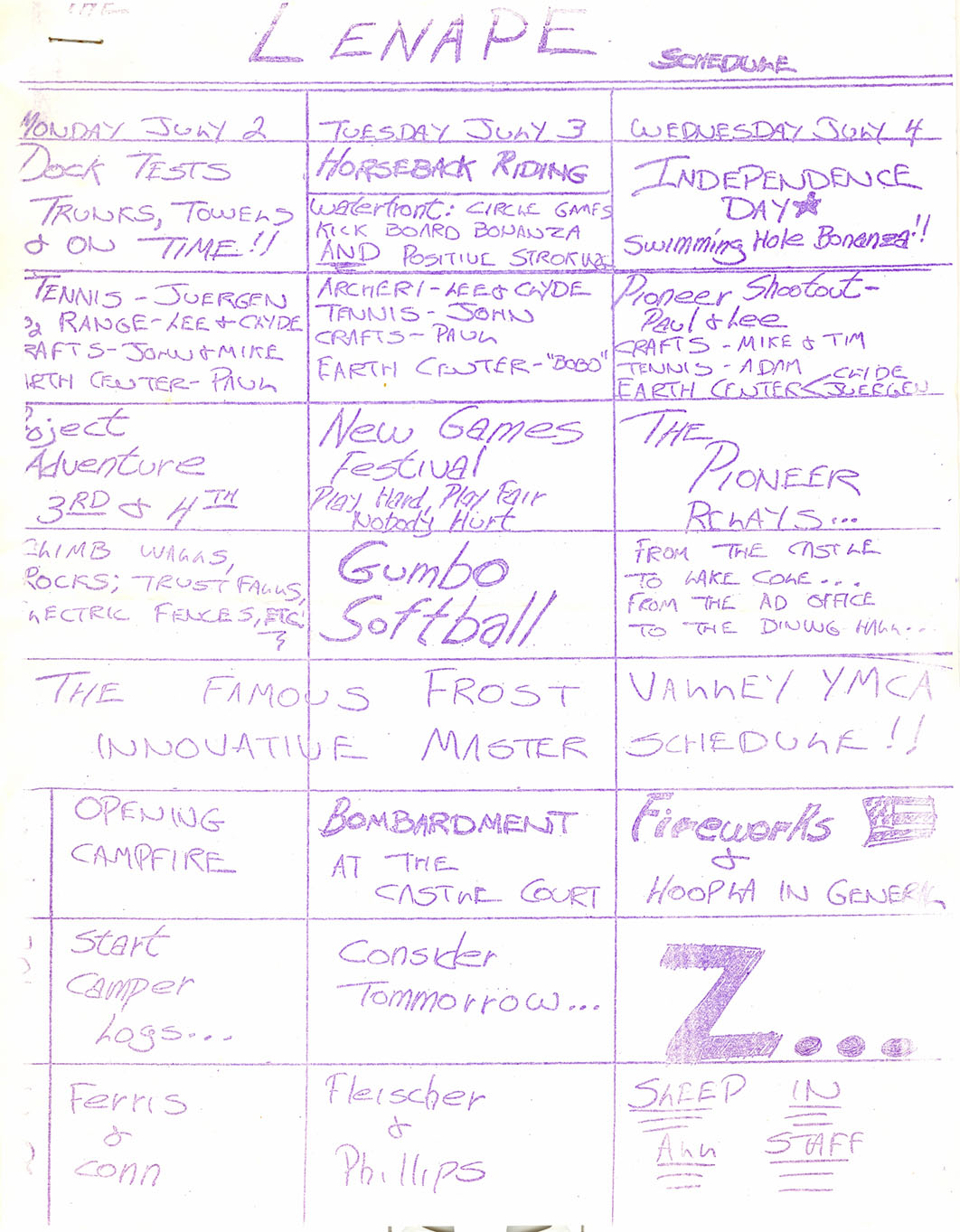
 Since the middle of the summer of 1976, each week the village chief of every village has created a weekly program schedule for the village. From '72 or so through the end of July '76 program activities were centralized - the famous "Master Schedule." Yes, all 5 activity periods were organized and managed and rostered by the Program Director(s). What a huge job that was. The advantages of the Master Schedule were obvious: campers had a huge diversity of choice. There were standard activities (crafts, basketball, etc.) as well as unusual ones (unicycles, learning Farsi) and there were at least 40 choices every period! The MS took advantage of the size of FV's staff and the range of talents. The down sides were enormous - two main ones: first, there was little to no accounting for where the campers were at any time; second, all the work had to be done by the Program Director and a few people who helped him or her. In all this, the importance of the village chief waned. By early '76 the VC was reduced to supervising the village staff at meals, rest hour, and evenings; scheduling CQ and days' off; some ongoing training; creating evening programs on nights when they were run by the village; handling overnights; being a super-counselor within the village. But the VCs didn't have authority and the uniqueness of the villages lessened.
I was the Program Director in August '75 and again was to be in August '76. (I was CIT Director in July '76. John Wellington Jr., who has been mentioned in these entries, was one of my CITs.) Just days before session 3 began, I was summoned by Halbe Brown and Bill Hettler to Halbe's office and was told to fix the problem with the program. "Create a system whereby we will know where every camper is at any time, and so that the villages will once again be the focal point of the campers' experiences." And Halbe handed me a model he'd used back at Camp Fitch, where he began in camping. I adapted this model quite a bit. I created a four-by-four grid. running alongside one edge of the grid were four groups of villages ("brother and sister" villages). Running down the other axis were four broad types of activities: 1) waterfront, 2) sports & games, 3) feeling good (wellness), 4) specialties. This would cover 4 periods every day and the 5th was reserved for a one-period version of the Master Schedule at the end of the day.
I called a meeting of all VCs and program staff for the Sunday night of the beginning of session 3. We met in the Castle living room. I brought mimeograph "stencil" sheets. I explained the new system to the VCs, who were dumbstruck. I told them that they would be creating one week's schedule and would have to do so with their brother or sister VC. They would also have to coordinate use of facilities, spaces, equipment through a system of sign-out sheets. We went around the room and each program area director described what was available that week. I asked them to insert all-camp programs. They blocked in their overnights, scheduled by Out-trip. I described the "specialty" options. They blocked in waterfront every day. The rest was up to them.
It took until well after midnight but they did it. I told them they would be mini-program directors and to make my point I asked Chuck White to come to the Castle at the end of the meeting and dramatically hand out BCB keys on nylon cord to each VC. Now each of them would be able to open the areas they were now responsible for - archery range, athletic shack, etc.
Within a few years we switched to photocopying the schedules, but very quickly they became elaborate. The first ones were rough blocked-out guides.
In the summer of '77 we began with the new programming format from the start and it seemed to work very well. The villages were back! The VCs were back in their central role. We continued to meet once a week and those meetings took on a great deal of general importance.
The system is in place today - almost exactly as it was back then. This coming summer it'll have been 32 years since that big change.
This morning I found one of the first schedules created - printed in purple ink by a mimeograph machine - for the first week of session 1 in the summer of '77. The VC was, I think, a guy named Gunnar. He was always the first one done with his schedule. (His one-week schedule took up two pages - he wrote large and fit only three days per side. As I say, we got better at this later.)
Click here for a much larger image and you can read it in detail. Below is a blow-up of one activity block: "NEW GAMES" were big then. "Everyone is a winner at Frost Valley. Gumbo!"

Sunday, November 11, 2007
he carried her tent for her
 A few summers ago Sandy Bohn (formerly Sandy Shapiro) and John Wellington were both judges at Challenge Night. One of the challenges involved the telling of stories about two very dear camp friends. The kids took their turns but then these two judges revealed that many years earlier they had been CITs together, and they proceeded to tell a short version of the story of their CIT (actually "LIT") backpacking trip.
The trip had been a difficult one, and John ended up carrying Sandy's tent for her. Here is a video recording of these two old friends, reunited at camp recently, telling of tough moments and enduring friendship.
Monday, July 30, 2007
small piece of the 1977 staff photo
 From the 1977 staff photo, here's a small crop: at the top, left to right, is Ray Honeywell, Stan "the Man" Treadway, and Carol Wolff; next row from the left is Mike Ketcham, then the VC of Lenape whose name I can't remember, then John Ferris; next row down from left is Halbe Brown and Jerry Piltzer; next row down, again from left, is Jody Davies (later Jody Davis Ketcham), Laurie Cobb, and Debbie Marsh; next row from left is Janet Reis (dark hair), Lynn Rowling and a woman whose name I can't remember; next row down, from left, is Janet Leston (or maybe not), then Mary Fleischauer of Stevens Point, Wis. (our nurse--mom of Kirk, who was also in camp), and our girls' program director Carol Sarabun (partly obscured by the curly-haired woman in front of her).
Stan Treadway probably holds a number of Frost Valley firsts. But let it be said here: Stan was literally the first person ever to come over the top of the Project Adventure wall. I'm going to guess that this was June 20-something, 1977.
Friday, July 27, 2007
alum's son is now VC of Outpost
 A little while back I mentioned that the son of Deb Trosvik, who once (1977, I think) was a village chief of Susky, is here again this summer as the VC of Outpost. He is Mike Mensik. Last night--the final night of the session (when as always the village staffs are asked to remain in the village: what we used to call "sleep-in" and what I think they now dub "all in")--I wandered around, visiting the CQ fires in Tacoma, Forest, Hemlock, Sacky, and Outpost. By the time I got to Outpost it was 12:45 am. Mike Mensik was there, filling out evaluation forms and waiting for the rest of his staff to come out of the cabins and back from various conversations (one counselor was discussing a black bear sighting with a camp director up the hill). Mike told me that it was the night for Outpost grilling and he proudly displayed items picked up on someone's day off: burger patties, jumbo shrimp, etc. I was exhausted and yet the thought of shrimp
  grilled over a fire, under the stars, on the last night of the session, appealed to me. In the end I didn't stay and it was a good thing: Mike told me this morning that the shrimp wasn't ready to eat until at least an hour later. He also said that "We had a visit from a friend at 2:30 am." He was speaking in front of his campers and by "friend" I knew he meant that village-friendly shrimp-attracted black bear. Above is a photo taken just a few minutes ago of Mike and his cabin. One of the kids is the great-grandson of our long-time friend, Helen Geyer. Helen was the first woman on FV's Board of Trustees and recently made a very generous gift to support the renovation of the old Girls' Dining Hall or Conover-English Hall, now re-named Geyer Hall. Another nice convergence of the FV generations. Above is Deb Trosvik in the 1977 staff photo.
Monday, July 16, 2007
2 kids of former staff are CITs now
 Here, to the left, is Katey Ghobrial, daughter of Rafik Melek (now known as Mark Rafik Ghobrial); and Mariah Bohn, daughter of Sandra Shapiro Bohn. Sandy and Rafik were both counselors (and Rafik a VC) many years ago; and Dan Shapiro, Sandy's brother, was a camper, CIT and LIT back in the late 60s and early 70s. Now Katey and Sandy are CITs together. (My son Ben will be a CIT during the second half of the summer--and he and they have come to know each other well over the years.) Peter Boyd's daughter Elizabeth is a Pokey counselor this summer. Sandy's older daughter Shaina as a counselor in Pokey too. Debra Trosvik (once a VC of Susky) has a son here: Mike Mensik, VC of Outpost. As for the children of alumni who are campers this summer, the list is too long for this entry, but perhaps I will add a few notes as the days pass here at camp.
Saturday, July 7, 2007
Giannotti's totem pole
 One of the most creative people I've ever met, John Giannotti spent an entire two-week session sitting out on the lawn in front of Hird Lodge carving a new totem pole from a huge tree Chuck White selected and felled for him. John was the camp director and seemed to be able to do all his work--talking with campers and staff, even taking phone calls on an extention dragged out the lodge's window--from that spot. At the end of the session the pole was done and it was time to put it in the ground at the entrance to the main part of camp. Take a look at several photos of this hilarious scene. No one can remember whether this was 1977 or '78. Asked to identify some people in these photos, Michele Palamidy wrote:
 Well in the first one i think that is Lou Senor from maintenance in the back [with mustache], Valerie Kay [the blonde on the truck], Karen Giannotti, with her head cut off, Bernard Gauthier [dialysis doctor] bent over near the totem, Paul Brown's back with the heart on his shirt, Jan Gickner on the ground to the right [curly hair, in overalls], and, sitting on the totem pole is one of the Kremers. [The little girl is Dani Giannotti.] Of course that is the indomitable Chuck White driving the backhoe in the later pictures!John Giannotti writes:
Michele's photos of the totem pole brought back so many wonderful memories. Seeing my then 6 or 7 year old daughter, Dani, in one of them induced incredible tears of joy. Your account of the carving, however, is totally inaccurate! You state that I did 'little else' for two weeks while carving it. Hey, I was Girl's Camp Director at the time! Carl Hess and Chuck White chopped down this twenty five foot hemlock and dragged it up the hill. We mounted just outside of Hird Lodge, where the Girls Camp Director's office was located. I remember getting an extension for the phone so that I could carve and talk to upset parents at the same time. Now THAT was multi-tasking!John Kremer remembers:
I remember that summer well, and can also recall having to repaint the Totem pole shortly after it was raised, the wood was still so green the paint just did not hold. By the way, the 'Kremer' that Michele recounts sitting on the pole was me - next to Lou Senor, in the dark blue shirt; also in the last photo I am working level with Chuck on getting the pole plumb. 1977 or '78 would have been my 2nd or 3rd summer on the maintenance crew, as one of Carl's and Chuck's boys.I suppose what intrigues me about this scene is that it is like so many others: it becomes mythic; everyone remembers it more or less similarly yet with different emphases; it serves as a springboard for associational memories. This was the time of our lives.
Subscribe to:
Posts (Atom)