Sunday, January 30, 2011
all around the Castle
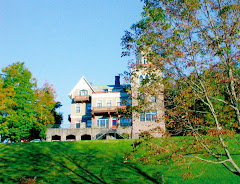
 Here's an almost 360-degree photo of the Castle main floor, taken by Ken Nathanson this weekend. Click on the image for a larger view. Below is a similar shot of the Castle office--Mr. Forstmann's old card room.


Wednesday, January 26, 2011

Tuesday, January 25, 2011
Wednesday, January 5, 2011
my Sierra cup, home again
 I received a package today from Glenn Horton. It contained two items. First, a logbook (with entries written by the campers) of a backpacking (and rock-climbing) trip to the Adirondacks which Glenn led along with Mandy Staples many years ago. And, secondly, my old Sierra cup. My very own. Oh, how did Glenn get it? Oh, how long it's been since I was parted from my dear ol Sierra cup. Was a time when I ate from it, drank from it, used it to transport dirt and worms (fishing), even dug with it once or twice. These things are like Swiss army knives, in their humble way. Anyway, it's mine mine mine. Even has my initials - "AF" - stamped on the bottom. Thanks, Glenn. Thanks for never forgetting. Thanks for realizing that we never forget how important these things are.
Saturday, January 1, 2011
friends since the early 1980s
 Allison, Kste and Molly (left to right) met as campers in the early 1980s and they continue to this day as the closest of friends. They were reunited at the place where this extraordinary lifelong friendship began--you guessed it, FV. At the September 2010 reunion.
Thursday, December 30, 2010
more about dialysis
Many Frost Valley friends are aware of our innovative program enabling children with renal disease to attend camp--a mainstreaming program we began in 1975 in partnership with the Gottscho Kidney Foundation of NJ and the Albert Einstein Medical College Hospital in the Bronx (the partnership there has since shifted to Montefiore Hospital). But many of us don't know much about pediatric kidney failure or about dialysis (the first treatment for those afflicted with the disease). Here, below, is a recent story about dialysis.
- - -
Dialysis: An Experiment In Universal Health Care
November 9, 2010
National Public Radio
by Robin Fields
 Every year, more than 100,000 Americans start dialysis treatment, a form of chronic care given to people with failing kidneys. And for many, the cost is completely free. Since 1972, when Congress granted comprehensive coverage under Medicare to any patient diagnosed with kidney failure, both dialysis and kidney transplants have been covered for all renal patients.
But a new joint investigation between The Atlantic and ProPublica found many problems with dialysis in the U.S.: The cost of treatment is among the world's highest, while the U.S. mortality rate for dialysis patients is one of the world's worst. One in four patients will die within 12 months of starting treatment.
Investigative reporter Robin Fields, who spent the past year reviewing thousands of documents and interviewing more than 100 patients, doctors, policymakers and experts, found systematic failures in the way dialysis centers are set up in the United States.
"At clinics from coast to coast, patients commonly receive treatment in settings that are unsanitary and prone to perilous lapses in care," she writes in a piece that will be published in the December issue of The Atlantic. "Regulators have few tools and little will to enforce quality standards. Industry consolidation has left patients with fewer choices of provider. [And] the government withholds critical data about clinics' performance from patients, the very people who need it most."
A Growing Industry
The kidney dialysis industry, Fields tells Fresh Air's Terry Gross, is now "hugely larger than anyone could have imagined."
"There are far more patients. There are far more complicated patients. And the expense of this is wildly beyond the expectations of the architects of the program," she says.
The program that initially cost the taxpayers $135 million a year is now a multibillion-dollar industry. The two chains that dominate the dialysis industry, DaVita and Fresenius, make about $2 billion combined in operating costs per year, she explains. And the industry is expected to grow: Every year, the pool of patients increases by 3 percent.
"When the program started, the original estimates thought there could be perhaps 35,000 patients," she says. "Then as that became clear that that wasn't going to be true, they thought maybe 50,000 patients -- then 90,000. But what's really happened is the patient community has continued to grow because of conditions like diabetes and obesity becoming so much more common in the larger health care system."
Six percent of all Medicare money, Fields writes, goes toward treating people with kidney failure. But Medicare doesn't set staffing ratios for dialysis clinics. Fields explains that clinics are required to have a medically licensed physician, but the physician is not always present for all dialysis treatments. Some nurses and licensed technicians juggle far more patients than what standards recommend. And some clinics turn over three to four shifts of patients a day.
"What we found in examining inspection reports as broadly and deeply as we could is that many of the same patterns cropped up time and time again: unsafe and unsanitary conditions; prescription and medical errors; issues in infection control; issues that dealt with the amount of staffing, the training of staff and the supervision of staff," Fields says. "I should emphasize, this isn't all clinics. Some clinics do a great job. But what we found, not only looking at inspections but at interviewing people broadly, was that some clinics are operating in a way that seems to ratchet up risks and that reflected some of the frustrations voiced by patients and doctors and other practitioners alike about one-size-fits-all care that didn't really give patients the best of the medicine that's available or the best of the treatment options available."
Transitioning To Private Care
Today more than 80 percent of the 5,000 dialysis centers operating in the United States are private, a major change from the mainly hospital-based care patients received in the 1970s and 1980s. Fields says the transition happened because the payment policies for dialysis treatment helped create financial incentives that allowed corporations to enter the market.
"The payment policies at the beginning were said to be quite generous and to draw providers in to create the desperately needed access that the [dialysis] program was based on," she says. "And the people who float in to create that access were mostly for-profit providers. ... Ultimately, as the payment policies evolved to somewhat suppress the price of each treatment, what you found happening was that that sort of favored providers who had economies of scale and could have purchasing power that lowered their cost. And the product of that has been a vast changeover in who provides the care."
She says that some reforms are in the works to improve patient care, including Medicare's plan to offer a set payment for patients' combined treatments and drugs, instead of paying for each separately. The combined payment, says Fields, removes the incentive for clinics to overuse drugs to generate profits.
"I think that mostly people in the dialysis world view these things as incremental improvements and not the things that could vault us forward in a major way," she says. "And they're hoping for further changes that lead to ... different definitions of quality and performance."
Robin Fields is a senior editor at ProPublica. She has received a National Journalism Award for her investigative reporting, as well as the Associated Press Managing Editors Public Service Award. [Copyright 2010 National Public Radio]
- - -
Dialysis: An Experiment In Universal Health Care
November 9, 2010
National Public Radio
by Robin Fields
 Every year, more than 100,000 Americans start dialysis treatment, a form of chronic care given to people with failing kidneys. And for many, the cost is completely free. Since 1972, when Congress granted comprehensive coverage under Medicare to any patient diagnosed with kidney failure, both dialysis and kidney transplants have been covered for all renal patients.
But a new joint investigation between The Atlantic and ProPublica found many problems with dialysis in the U.S.: The cost of treatment is among the world's highest, while the U.S. mortality rate for dialysis patients is one of the world's worst. One in four patients will die within 12 months of starting treatment.
Investigative reporter Robin Fields, who spent the past year reviewing thousands of documents and interviewing more than 100 patients, doctors, policymakers and experts, found systematic failures in the way dialysis centers are set up in the United States.
"At clinics from coast to coast, patients commonly receive treatment in settings that are unsanitary and prone to perilous lapses in care," she writes in a piece that will be published in the December issue of The Atlantic. "Regulators have few tools and little will to enforce quality standards. Industry consolidation has left patients with fewer choices of provider. [And] the government withholds critical data about clinics' performance from patients, the very people who need it most."
A Growing Industry
The kidney dialysis industry, Fields tells Fresh Air's Terry Gross, is now "hugely larger than anyone could have imagined."
"There are far more patients. There are far more complicated patients. And the expense of this is wildly beyond the expectations of the architects of the program," she says.
The program that initially cost the taxpayers $135 million a year is now a multibillion-dollar industry. The two chains that dominate the dialysis industry, DaVita and Fresenius, make about $2 billion combined in operating costs per year, she explains. And the industry is expected to grow: Every year, the pool of patients increases by 3 percent.
"When the program started, the original estimates thought there could be perhaps 35,000 patients," she says. "Then as that became clear that that wasn't going to be true, they thought maybe 50,000 patients -- then 90,000. But what's really happened is the patient community has continued to grow because of conditions like diabetes and obesity becoming so much more common in the larger health care system."
Six percent of all Medicare money, Fields writes, goes toward treating people with kidney failure. But Medicare doesn't set staffing ratios for dialysis clinics. Fields explains that clinics are required to have a medically licensed physician, but the physician is not always present for all dialysis treatments. Some nurses and licensed technicians juggle far more patients than what standards recommend. And some clinics turn over three to four shifts of patients a day.
"What we found in examining inspection reports as broadly and deeply as we could is that many of the same patterns cropped up time and time again: unsafe and unsanitary conditions; prescription and medical errors; issues in infection control; issues that dealt with the amount of staffing, the training of staff and the supervision of staff," Fields says. "I should emphasize, this isn't all clinics. Some clinics do a great job. But what we found, not only looking at inspections but at interviewing people broadly, was that some clinics are operating in a way that seems to ratchet up risks and that reflected some of the frustrations voiced by patients and doctors and other practitioners alike about one-size-fits-all care that didn't really give patients the best of the medicine that's available or the best of the treatment options available."
Transitioning To Private Care
Today more than 80 percent of the 5,000 dialysis centers operating in the United States are private, a major change from the mainly hospital-based care patients received in the 1970s and 1980s. Fields says the transition happened because the payment policies for dialysis treatment helped create financial incentives that allowed corporations to enter the market.
"The payment policies at the beginning were said to be quite generous and to draw providers in to create the desperately needed access that the [dialysis] program was based on," she says. "And the people who float in to create that access were mostly for-profit providers. ... Ultimately, as the payment policies evolved to somewhat suppress the price of each treatment, what you found happening was that that sort of favored providers who had economies of scale and could have purchasing power that lowered their cost. And the product of that has been a vast changeover in who provides the care."
She says that some reforms are in the works to improve patient care, including Medicare's plan to offer a set payment for patients' combined treatments and drugs, instead of paying for each separately. The combined payment, says Fields, removes the incentive for clinics to overuse drugs to generate profits.
"I think that mostly people in the dialysis world view these things as incremental improvements and not the things that could vault us forward in a major way," she says. "And they're hoping for further changes that lead to ... different definitions of quality and performance."
Robin Fields is a senior editor at ProPublica. She has received a National Journalism Award for her investigative reporting, as well as the Associated Press Managing Editors Public Service Award. [Copyright 2010 National Public Radio]
Thursday, December 23, 2010
let's send kids to camp next summer!
 This holiday season I have been raising money to send kids with kidney failure to camp next summer. My goal is $13,000 and I'm now at $11,770. I invite readers of my blog to go here (frostvalley.kintera.org/yearend2010/afilreis) and consider--please--making a donation. The gift you make for this kids is fully tax deductible, and the online system is good and secure, I promise.
 I've been associated with Frost Valley since I was 8 years old. I was a camper, then a counselor, then a director for many summers and now proudly serve as a member of the Board of Trustees.
 In 1975, Frost Valley partnered with the Ruth Gottscho Kidney Foundation to become the first camp in the world to offer children with kidney disease a chance to experience summer camp ("mainstreamed" with healthy kids) while also receiving their dialysis treatments. These children have experienced sleepaway camp while gaining confidence and independence in what is typically their first time away from family and home. Most learn new skills for managing and coping with their medical condition. I've seen this program succeed miraculously for 30 years.
The cost of sending one child on dialysis to camp for a two-week session is $1,500. Will you join me and please make a donation today?
Saturday, December 18, 2010

at the reunion

From left to right: Lillian Rountree Lippincott, Lisa Ernst and Eileen Bradley at the recent reunion.
Sunday, December 12, 2010
Sunday, December 5, 2010

Wednesday, December 1, 2010
Gorm Fosdal returns
 Gorm Fosdal was an international counselor in 1982 and visited briefly in '85. He and his family (his wife and two kids, 19 and 22) visited Frost Valley recently. Gorm hadn't been back in 25 years. He was a counselor in Hemlock which in those days was housed in cabins 21-25. His was 25. The photo here shows Gorm sitting in front of cabin 25 once again. Below is what Gorm wrote about this trip and he asks us to forgive his imperfect English:
I had a very nice return to New York and Frost Valley with all my family, and youngsters aged 18 and 22 were ready to stay in the City. They just loved it. We were lucky to be blessed with very nice weather in The Big Apple, and though nice sunny weather very cold and some dazzle in the Catskills.
It was very nice to be back at Frost Valley, but also strange as it was the first time being there without the many children in the summer. I was counselor in 1982 and visited FV twice in the summer of 85, after touring US for 5 weeks. It was great being there and we, because of the weather, drove more than walked around, which was a big change from the time being a counselor, where the shoes were much in use.
My wife Anne Marie was a cuonselor also in the Catskills in 1981, close to Parksville near Elko Lake at a camp run by The Presbyterian Church. We found the surroundings the next day, but it has not been a camp for years, and now private property.
Being there again is just like it was yesterday though it is 25 years ago, but thats how wonderful memories are for your life. In Liberty we met some other people also on a memory lane tour, who thought we were from Canada with our strange language, and were very surprised that Europeans found this small place in the US of all places.
Wednesday, November 24, 2010
starry night over Big Tree

Surely this is the most beautiful photograph I've seen of Big Tree. It was taken last spring on an especially starry night.
Tuesday, November 23, 2010

Friday, November 19, 2010
alumni benches, lifer bricks
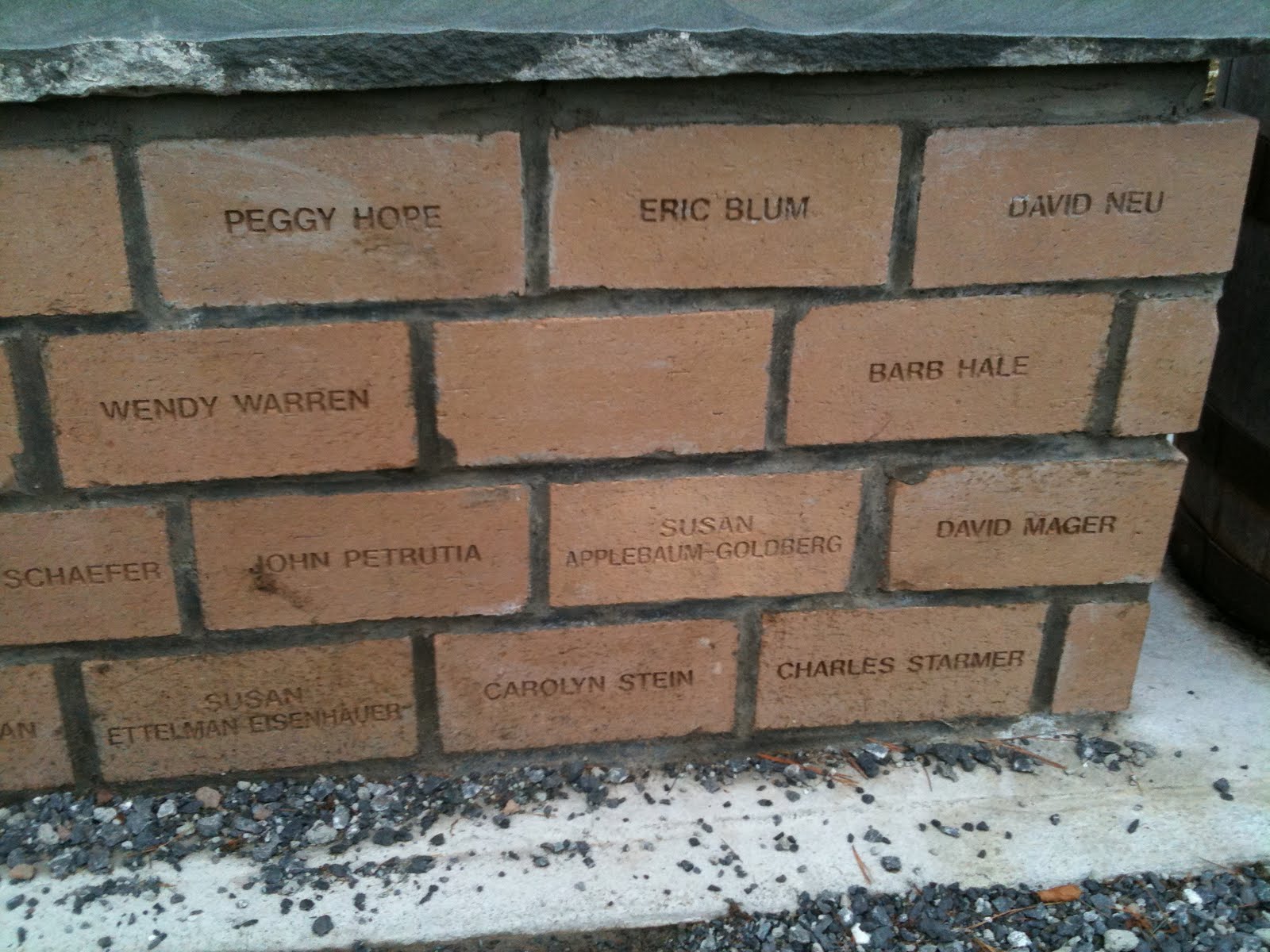

 At various spots around camp now there are alumni benches, built on the "lifer bricks" many of us received through several projects. Some of us got them at the 2006 reunion. In an earlier period lifer bricks were given to campers as they "graduated" from their final summer as camper, just before the CIT summer. For a few years these were stacked somewhere while we figured out the best way to display them. These benches have gotten very positive reviews so far.
You can get your own lifer brick. Go here, click on the link to the form, make a gift to Frost Valley (send a kid to camp!) and the brick will be imprinted with your name and built into one of the new benches.
Sunday, November 7, 2010
grim November

 Both these photos were taken yesterday. Temps in the 40s and 30s. A few flurries in the morning. Dim all around.
Sunday, October 24, 2010
stopping with a sugar high after a stint at Katz's Bakery in Liberty
 Coming back from Katz's bakery in Liberty. From left to right: Kenny Nathanson, Bill Walton, Bob Davis, Kevin Hanlon. I'm not 100% certain the fellow on the right is Kevin Hanlon, but I'm pretty certain. Can someone help? Anyway, whether or not this is Kevin, I should note, sadly, that Kevin died in an accident not more than a few years after his one or two summers at FV.
Saturday, October 16, 2010
Forest village in the late 60s
 Forest Village, late 60s. Mark Kramer was a JC here. Mark is one of those standing on the porch right in front of the door, t-shirt, blond hair, standing tall and looking straight at the camera. According to Sven Grotrian (this is Sven's photo) Mark was promoted to counselor that same summer. Sven is kneeling toward the front: two or three rows from the front, depending how you count, and he's 4th in from the left, blond hair, mustache, wearing a wool cap, two to the right of the camper wearing #82. Standing to the far right, the furthest right, is a camper--Steve Ernst. Steve's sister Lisa has long been actively involved with FV and is on the staff now as the director of major gifts in our development office. I believe I also see Steve Glade, white shirted, blonde hair combed down over his eyes, furthest to the right of those standing on the porch/stairs. Click on the photo for a larger view.
Friday, October 15, 2010

John Paul Thomas
 John Paul Thomas in the summer of 1972 - at the Wawayanda Chapel one Sunday morning. I'll be he was singing "If I Had a Hammer." At other occasions - especially in later years - he sang a gorgeous version of "Rambling Boy." JPT started in around 1967 and in either '67 or '68 was our Archery Director. I think he was also, at least one summer, the Totam VC. In the early 70s he was a CIT Director, the LIT Director, and the did perhaps two summers as half-summer (July) Program Director. Some years later he came back and did stints as FV's Conference Director, living at camp all year. Last I heard, he was in North Carolina.
Sunday, October 3, 2010
when Sequoia first started
 Here's a photo of Sequoia - during its first-ever summer. (Was it 1971 or '72?) The barn out there had been known as the "Trailblazers Barn" at first, home base for our Canada-bound canoe program. At some point in the 1960s it was also the home of the "CE's" - "construction engineers." Then it was "the CIT Barn" for a few years before the Crafts Shop barn was renovated into Hayden Lodge ('70). Once CITs moved into Hayden, Sequoia was created as the Adventure Village and that's--again--when this shot was taken (by Sven Grotrian). The guy you seeing wandering into "the lair" was Pat Ricciardi, one of the early and most avid Sequoia guys.
Ken Nathanson says the first Sequoia summer was '73: "I was in Sequoia the first year it was formed. The year was 1973. In addition to Pat and Sven, Rick Cobb was also a staff member that year. Perhaps in time another name or two will come to mind. It was perhaps one of my favorite years as a camper."
four musketeers on check-out day
 From left to right, standing: Sven Grotrian, Doug Tompkins, Pat Ricciardi; below, Al Filreis. This is almost certainly 1973. I'm going to guess that Sven was LIT Director, Doug was CIT Director and Pat was VC of Sequoia, but that's an off-handed guess. Doug is wearing that summer's popular shirt: a three-quarters sleeved baseball jersey with the "73" on it.
Friday, October 1, 2010
Big Tree Field, flooded
 This morning there was a lake in the Big Tree Field. Big Tree Field Lake is I suppose what it needs to be called. Last night and this morning the region was buffeted by high winds and sheets of hard rain. One could hear boulders rumbling down Biscuit Creek. The road from Claryville was washed out.

Tuesday, September 28, 2010
the origin of Mount Hayden
Stan Treadway tells of the origin of Mount Hayden:
- - -
Maybe I can fill in a few of the 'blanks' concerning the origins of Mt. Hayden:
In the Fall of 1976 Don Freed and Chuck White put together the permanent anchor cable on the chimney and positioned the belay rock that later became Mt. Hayden. (I helped just a little bit!) Don's background in adventure education was influenced by stints at the Lorado Taft Field Campus/NIU, Oregon, Illinois, and the Clear Lake facility affiliated with the Battle Creek Public School system. By the time he and I ran into one another at Frost Valley we both realized how ripe the environmental program was to evolve into 'challenge' activities. With Jim Marion's blessings, and a solid plan grounded in Project Adventure models, Mt. Hayden became, as I recall, the first permanent element in a trust-building/group dynamics emphasis that school groups could take advantage of while in residence.
 We enjoyed Don's influence for only one environmental season and then he embarked on a journey that would eventually lead to his doctorate in education and a tenured position in Traverse City, Michigan. Don's influence on my life was three fold: I attended a week-long Project Adventure summit and became certified in all things relating to 'group dynamics'; I too attended Northern Illinois University's Taft Campus and completed a master's in outdoor teacher education, and finally thanks to Don's urging, I graduated from a three+week Outdoor Educator's Course through the National Outdoor Leadership School (NOLS) in Lander Wyoming. Little does Don realize how many people have benefited from his vision in 1976 and the tracks he has left behind, especially in my life. I plan to share this Mt. Hayden update with him. He left Frost Valley a long time ago, and knowing Don, he never looked back, only forward to HIS next horizon. He is now a family man living smack dab in the middle of orchards for as far as the eye can see, and a front yard complete with a putting green. He and I have paddled in several down-river canoe races in central Wisconsin, but the last I saw of him was Spring 2001 while traveling with my mother on the return leg of a Canadian vacation. I am soooo grateful Frost Valley brought our two wandering lives together, however briefly.
The photo above and at right shows Dave Nalven and Stevie Bell moments after Stevie successfully climbed Mount Hayden in 1984.
- - -
Maybe I can fill in a few of the 'blanks' concerning the origins of Mt. Hayden:
In the Fall of 1976 Don Freed and Chuck White put together the permanent anchor cable on the chimney and positioned the belay rock that later became Mt. Hayden. (I helped just a little bit!) Don's background in adventure education was influenced by stints at the Lorado Taft Field Campus/NIU, Oregon, Illinois, and the Clear Lake facility affiliated with the Battle Creek Public School system. By the time he and I ran into one another at Frost Valley we both realized how ripe the environmental program was to evolve into 'challenge' activities. With Jim Marion's blessings, and a solid plan grounded in Project Adventure models, Mt. Hayden became, as I recall, the first permanent element in a trust-building/group dynamics emphasis that school groups could take advantage of while in residence.
 We enjoyed Don's influence for only one environmental season and then he embarked on a journey that would eventually lead to his doctorate in education and a tenured position in Traverse City, Michigan. Don's influence on my life was three fold: I attended a week-long Project Adventure summit and became certified in all things relating to 'group dynamics'; I too attended Northern Illinois University's Taft Campus and completed a master's in outdoor teacher education, and finally thanks to Don's urging, I graduated from a three+week Outdoor Educator's Course through the National Outdoor Leadership School (NOLS) in Lander Wyoming. Little does Don realize how many people have benefited from his vision in 1976 and the tracks he has left behind, especially in my life. I plan to share this Mt. Hayden update with him. He left Frost Valley a long time ago, and knowing Don, he never looked back, only forward to HIS next horizon. He is now a family man living smack dab in the middle of orchards for as far as the eye can see, and a front yard complete with a putting green. He and I have paddled in several down-river canoe races in central Wisconsin, but the last I saw of him was Spring 2001 while traveling with my mother on the return leg of a Canadian vacation. I am soooo grateful Frost Valley brought our two wandering lives together, however briefly.
The photo above and at right shows Dave Nalven and Stevie Bell moments after Stevie successfully climbed Mount Hayden in 1984.
Friday, September 24, 2010

Wednesday, September 22, 2010
Morrie Hubbard was 101 years old
 G. Morrison Hubbard , Jr., died peacefully, Aug. 21, 2010, at his home in Summit, N.J. He was 101. Born in 1909, he resided in Summit, all of his life.
 Mr. Hubbard was the oldest camper from one of the oldest camps in the country, Camp Keewadyn in Salisbury, Vermont. Before he was 15, he had built up a writing paper business in eight surrounding towns and had about 200 customers. At 17, he had crossed the country with three other boys, in a second-hand Buick, returning home by working on a cargo freighter, the day before school started. It stopped at three Mexican ports and went through the Panama Canal.
Although his favorite camp was elsewhere, Morrie Hubbard was a good friend of Frost Valley. He came to us through Woody English, long-time chairman of FV's Board of Trustees. Morrie also sat on the Board of the Hyde and Watson Foundation for many years; Hyde & Watson has been very generous with Frost Valley--their many grants to Frost Valley have been honored in the naming of one of our large lodges. Back in early 2001, Morrie made a donation of $10,000 to our then-just-emergent farm program.
Tuesday, September 21, 2010
hiking boots are cool
A former camper from the 60s/70s remembers me this way:
"I remember you there at Wawayanda. Mom sent me off one year wearing these shoes with large, thick, waffle type soles on them. When I objected, Mom told me they were hiking shoes and everyone at camp would be wearing them too. Everyone else had sneakers. My hiking shoes were "out of place" it seemed until I spotted a counselor wearing them. YUP - it was you!! Hiking shoes are much "cooler" and even a wanted item if counselors wear them."
I love this story!
"I remember you there at Wawayanda. Mom sent me off one year wearing these shoes with large, thick, waffle type soles on them. When I objected, Mom told me they were hiking shoes and everyone at camp would be wearing them too. Everyone else had sneakers. My hiking shoes were "out of place" it seemed until I spotted a counselor wearing them. YUP - it was you!! Hiking shoes are much "cooler" and even a wanted item if counselors wear them."
I love this story!
Monday, September 20, 2010
daughter of Audrey Griffin Jones needs your help
Here is a sad note posted to Facebook by Jen Antinoro Storey on behalf of her friend, and our friend, Audrey Griffin Jones:
- - -
I apologize for the mass email but I am reaching out to my entire Teaneck & Frost Valley community. As some of you may already know, my oldest friend Audrey (Griffin) Jones’ daughter was recently diagnosed with DIPG, a rare and inoperable tumor on the brain stem and one of the most devastating pediatric malignancies. Shannon will be 7 years old next month. Audrey and I grew up together in Teaneck and spent every summer together at Frost Valley sleep away camp (1980 until early 90’s). A website is being set up so that Audrey can provide updates on Shannon. I will be sure to send that link once I have it.
A fundraiser has been planned for Sat. Oct. 9 in New Jersey to help the Jones family provide the care that Shannon needs. (Details below on how to lend support if you are unable to attend)
When: Saturday, October 9th (3pm-?)
Where: General Poors Tavern; 45 Main Street; Hackensack, NJ 07601
$20 per person suggested minimum donation at the door (Cash only please)
Food, drinks, live music , raffles, and 50/50
Bring the whole family!
If you are unable to attend and you wish to contribute support, you may send checks (made out to Audrey Jones), Shoprite or Trader Joe’s Gift-cards to:
Certified Financial Services
Attn: Pamela Mellor
52 Forest Ave
Paramus, NJ 07652
Thank you!
Jen (Antinoro) Storey
- - -
I apologize for the mass email but I am reaching out to my entire Teaneck & Frost Valley community. As some of you may already know, my oldest friend Audrey (Griffin) Jones’ daughter was recently diagnosed with DIPG, a rare and inoperable tumor on the brain stem and one of the most devastating pediatric malignancies. Shannon will be 7 years old next month. Audrey and I grew up together in Teaneck and spent every summer together at Frost Valley sleep away camp (1980 until early 90’s). A website is being set up so that Audrey can provide updates on Shannon. I will be sure to send that link once I have it.
A fundraiser has been planned for Sat. Oct. 9 in New Jersey to help the Jones family provide the care that Shannon needs. (Details below on how to lend support if you are unable to attend)
When: Saturday, October 9th (3pm-?)
Where: General Poors Tavern; 45 Main Street; Hackensack, NJ 07601
$20 per person suggested minimum donation at the door (Cash only please)
Food, drinks, live music , raffles, and 50/50
Bring the whole family!
If you are unable to attend and you wish to contribute support, you may send checks (made out to Audrey Jones), Shoprite or Trader Joe’s Gift-cards to:
Certified Financial Services
Attn: Pamela Mellor
52 Forest Ave
Paramus, NJ 07652
Thank you!
Jen (Antinoro) Storey
autumn bikes rank Frost Valley road high
 Frost Valley Road is featured on a web site written by motorcyclists who search for the best weekend rides. Click here and either scroll down until you see Frost Valley or use "find" and search for "Frost Valley."
Friday, September 17, 2010
the longest hike he took in six summers at FV
 Bill Madden was sorry he missed the recent reunion. But it got him thinking about influential leadership and in particular about Bob Whirty when Bob was Bill's fellow camper in Sequoia (Adventure Village). I'll let Bill himself tell the story:
I have been visiting your alumni blog and saw the picture of Bob Whirty and his daughter. Seeing the picture reminded me of something remarkable Bob did as a camper. Here is my memory of what Bob did:
It was the longest hike I ever recall making in six summers at Frost Valley. The counselors leading us were a fellow we called “ Beefo” and another named Charlie. As it often happened on hikes, there was a somewhat overweight camper who could not keep up with the group. We frequently had to stop and wait for this slow fat kid to catch up. When he would finally arrive, at least one, and usually several of the campers would harshly ridicule him about holding us up. With head down, the poor, thoroughly exhausted camper would ashamedly offer a typical excuse of “my back pack is broken” or something along those lines. A counselor would make the obligatory check of the backpack, on occasion maybe even repack it and give a few items to others to carry. It was customary on camp hikes for one counselor to bring up the rear. But on this hike, even the counselor bringing up the rear grew weary of pushing the slow camper and took to calling over his shoulder to hurry and catch up.
Late in the day, we had walked so far ahead; this camper was no longer even in sight. Eventually a small dot appeared and as the dot grew closer we could see Bob Whirty walking with him. Bob was a regular on hiking trips and we all knew Bob had no trouble keeping up. When they finally arrived, we were well rested and would have already resumed our hike but for waiting. The counselor’s tone reflected the feeling of many of us when he impatiently told them to take only a short break as the rest of us were ready to go and it was getting late in the day.
Bob Whirty replied “no, you guys keep resting, we are going on”. The slow poke, although soaked in sweat, was no longer ashamed and echoed Bob. “Yes, we’re going to keep on going”. Bob never said the obvious. He did not try to deflect criticism from himself by pointing out that he was making sure the fat kid kept up.
NO. Bob said WE!! And we all could see Bob’s new friend believed it. The young camper’s face clearly showed he no longer considered himself a burden to the group. Now, he was a hiking companion of Bob Whirty and they were accomplishing a rewarding and challenging hike together. The rest of us were so impressed we remained where we were and allowed them to build a good lead. All of us, campers and counselors alike, were now anxious to do our part to follow Bob’s example and make him feel an equal and not an outcast. Bob gave us the opportunity to be part of one of those “Hallmark Moments” that happen at summer camp.
Monday, September 13, 2010
assorted favorites reunited (video & audio)
At the reunion Vespers - the theme was friendship - Lexi Cariello, Chris Harper and Chrissy Mohle reunited as a group known in recent years as "Assorted Favorites" to sing an absolutely beautiful and apt song for the occasion. There's no way to say here--not without the need of filling too many screens of text--exactly why this song is apt. You'll have to trust me, if you weren't there, that it was. They (as it is said) had their audience, had us, held us, holding our breaths. And then it was over.
Here is both a video (YouTube - click on the dark image above) and also audio-only (downloadable MP3). I'd go for the MP3 if I were you: download it and stick it on your iPod. Then when someone asks you to explain the magic of Frost Valley, pull out your tunes and play them this one. (To stream the audio, click on the sideways triangle in the link above. To download, right-click on "MP3.")
Here is both a video (YouTube - click on the dark image above) and also audio-only (downloadable MP3). I'd go for the MP3 if I were you: download it and stick it on your iPod. Then when someone asks you to explain the magic of Frost Valley, pull out your tunes and play them this one. (To stream the audio, click on the sideways triangle in the link above. To download, right-click on "MP3.")
then Chuck White came with the world's largest shovel
At the beginning of the "in memoriam" service at Reflection Pond (during the recent big Labor Day reunion), I sang "Old Wawayanda." (Video shot by Mike Marder.)
Subscribe to:
Posts (Atom)